## Chart: NMSE vs. Iterations for Model Complexity
### Overview
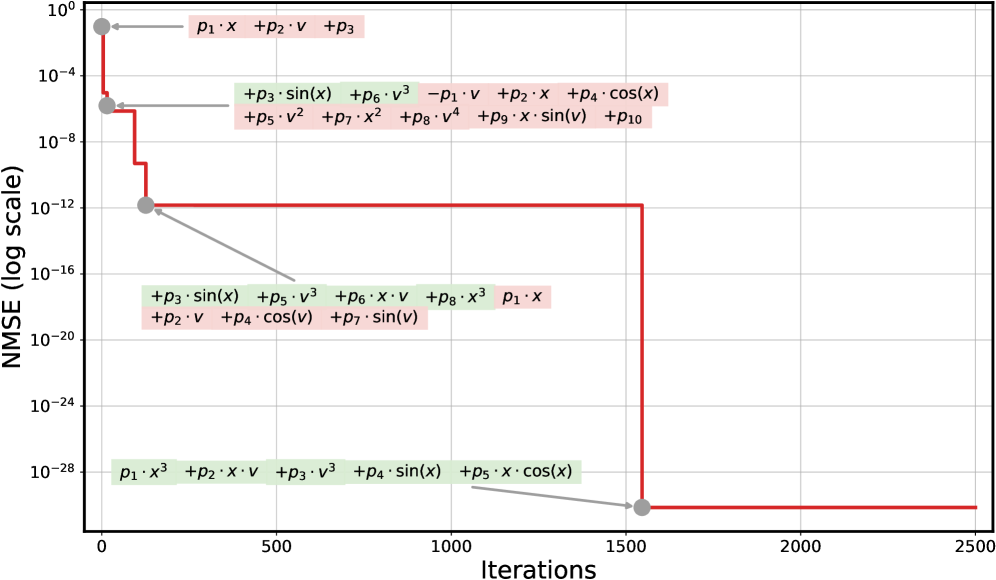
This chart displays the Negative Mean Squared Error (NMSE) on a logarithmic scale as a function of the number of iterations. The chart illustrates how the NMSE decreases with increasing model complexity (number of terms in the polynomial) and iteration count. Multiple lines represent different polynomial models, showing their convergence behavior.
### Components/Axes
* **X-axis:** Iterations (ranging from 0 to approximately 2500).
* **Y-axis:** NMSE (log scale, ranging from 10<sup>-30</sup> to 10<sup>0</sup>).
* **Lines:** Four distinct lines representing different polynomial models.
* **Markers:** Circular markers are placed at specific points along each line, likely indicating key stages or evaluations.
* **Legend:** Located in the top-left corner, labeling each line with its corresponding polynomial expression.
### Detailed Analysis
The chart shows four lines, each representing a polynomial model with increasing complexity.
* **Line 1 (Gray):** p<sub>1</sub>⋅x + p<sub>2</sub>⋅v + p<sub>3</sub>. This line starts at approximately NMSE = 6.0 x 10<sup>-7</sup> at iteration 0. It decreases steadily until approximately iteration 1500, where it drops sharply to approximately 2.0 x 10<sup>-25</sup>. The trend is initially a gentle slope downwards, followed by a near-vertical drop.
* **Line 2 (Orange):** +p<sub>3</sub>⋅sin(x) + p<sub>6</sub>⋅v<sup>3</sup> - p<sub>1</sub>⋅v + p<sub>2</sub>⋅x + p<sub>4</sub>⋅cos(x) + p<sub>5</sub>⋅v<sup>2</sup> + p<sub>7</sub>⋅x<sup>2</sup> + p<sub>8</sub>⋅v<sup>4</sup> + p<sub>9</sub>⋅x⋅sin(v) + p<sub>10</sub>. This line begins at approximately NMSE = 2.0 x 10<sup>-8</sup> at iteration 0. It decreases slowly until approximately iteration 1500, where it drops sharply to approximately 2.0 x 10<sup>-25</sup>. The trend is a very gradual decline, followed by a steep drop.
* **Line 3 (Green):** +p<sub>3</sub>⋅sin(x) + p<sub>6</sub>⋅v<sup>3</sup> + p<sub>2</sub>⋅x + p<sub>4</sub>⋅cos(v) + p<sub>7</sub>⋅sin(v). This line starts at approximately NMSE = 2.0 x 10<sup>-16</sup> at iteration 0. It remains relatively flat until approximately iteration 1500, where it drops to approximately 2.0 x 10<sup>-25</sup>. The trend is almost horizontal, then a sharp decline.
* **Line 4 (Red):** p<sub>1</sub>⋅x<sup>3</sup> + p<sub>2</sub>⋅x⋅v + p<sub>3</sub>⋅v<sup>3</sup> + p<sub>4</sub>⋅sin(x) + p<sub>5</sub>⋅x⋅cos(x). This line begins at approximately NMSE = 2.0 x 10<sup>-25</sup> at iteration 0. It remains flat until approximately iteration 1500, where it drops to approximately 2.0 x 10<sup>-25</sup>. The trend is flat.
The markers on the gray line are located at approximately:
* (0, 6.0 x 10<sup>-7</sup>)
* (500, 5.0 x 10<sup>-10</sup>)
* (1000, 2.0 x 10<sup>-12</sup>)
* (1500, 2.0 x 10<sup>-25</sup>)
The markers on the orange line are located at approximately:
* (0, 2.0 x 10<sup>-8</sup>)
* (500, 1.0 x 10<sup>-10</sup>)
* (1000, 2.0 x 10<sup>-12</sup>)
* (1500, 2.0 x 10<sup>-25</sup>)
The markers on the green line are located at approximately:
* (0, 2.0 x 10<sup>-16</sup>)
* (500, 2.0 x 10<sup>-16</sup>)
* (1000, 2.0 x 10<sup>-16</sup>)
* (1500, 2.0 x 10<sup>-25</sup>)
The markers on the red line are located at approximately:
* (0, 2.0 x 10<sup>-25</sup>)
* (500, 2.0 x 10<sup>-25</sup>)
* (1000, 2.0 x 10<sup>-25</sup>)
* (1500, 2.0 x 10<sup>-25</sup>)
### Key Observations
* All models converge to a similar NMSE value (approximately 2.0 x 10<sup>-25</sup>) after 1500 iterations.
* The simplest model (gray line) shows the most significant initial improvement in NMSE.
* The more complex models (orange, green, and red lines) start with lower NMSE values and exhibit slower initial improvement.
* The sharp drop in NMSE around iteration 1500 suggests a significant change in the optimization process or a convergence point.
* The red line remains constant throughout the iterations, indicating it has already reached its optimal performance.
### Interpretation
The chart demonstrates the relationship between model complexity, iteration count, and prediction error (NMSE). Initially, increasing model complexity leads to lower error, but beyond a certain point, adding more terms does not significantly improve performance. The convergence around iteration 1500 suggests that the optimization algorithm has reached a stable state for all models. The fact that all models converge to the same NMSE value indicates that the data may not require a highly complex model to achieve good performance. The red line's constant NMSE suggests it may have already reached its maximum representational capacity or is overfitting. This chart is likely used to evaluate the effectiveness of different polynomial models in fitting a given dataset and to determine the optimal level of model complexity. The logarithmic scale on the Y-axis emphasizes the large range of NMSE values and highlights the substantial error reduction achieved by the models.