## Pie Charts: Performance Distribution Across Three Datasets
### Overview
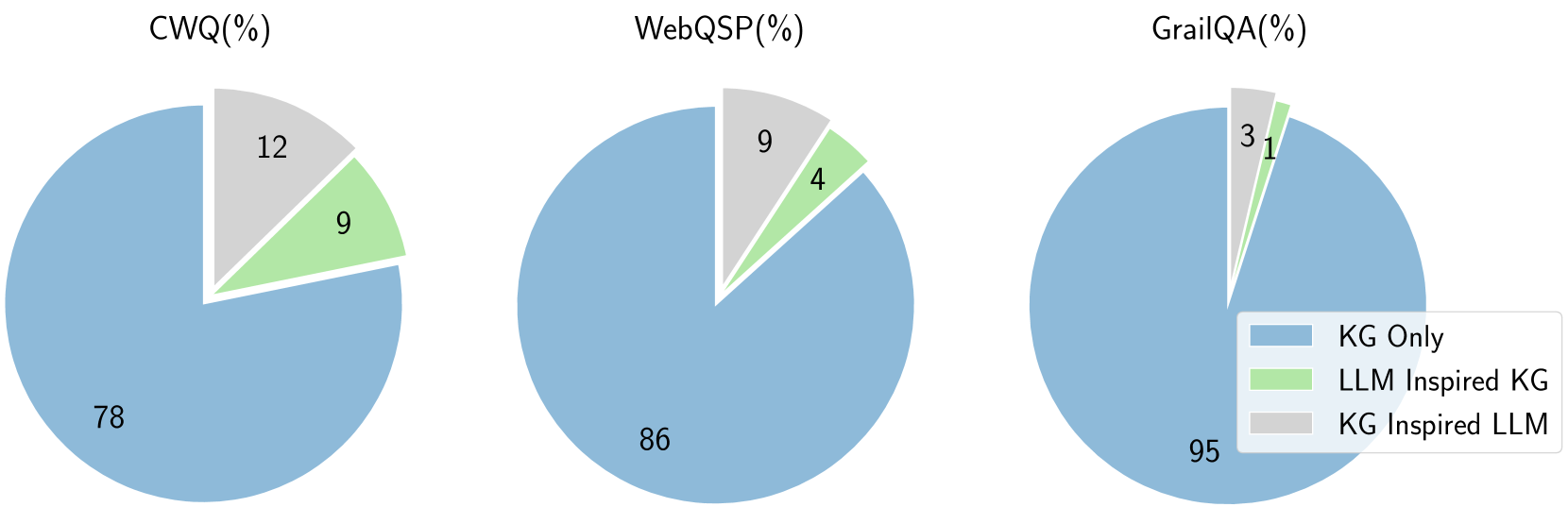
The image displays three pie charts arranged horizontally, each representing the percentage distribution of three distinct methodological categories across three different question-answering datasets: CWQ, WebQSP, and GrailQA. The charts compare the relative contribution or performance share of "KG Only," "LLM Inspired KG," and "KG Inspired LLM" approaches.
### Components/Axes
* **Chart Titles (Top Center of each pie):**
* Left Chart: `CWQ(%)`
* Middle Chart: `WebQSP(%)`
* Right Chart: `GrailQA(%)`
* **Legend (Bottom Right of the image):**
* A blue square corresponds to the label `KG Only`.
* A light green square corresponds to the label `LLM Inspired KG`.
* A light gray square corresponds to the label `KG Inspired LLM`.
* **Data Representation:** Each pie chart is divided into three colored segments (blue, light green, light gray) with numerical percentage labels embedded within them.
### Detailed Analysis
**1. CWQ(%) Chart (Left):**
* **KG Only (Blue):** Dominates the chart, occupying the largest segment. The label indicates **78%**. This segment starts from the 12 o'clock position and sweeps clockwise to approximately the 9:30 position.
* **KG Inspired LLM (Light Gray):** The second-largest segment. The label indicates **12%**. It is positioned in the top-right quadrant, adjacent to the blue segment.
* **LLM Inspired KG (Light Green):** The smallest segment. The label indicates **9%**. It is positioned between the gray and blue segments in the top-right quadrant.
**2. WebQSP(%) Chart (Middle):**
* **KG Only (Blue):** Again the dominant segment, with an increased share. The label indicates **86%**.
* **KG Inspired LLM (Light Gray):** The second-largest segment, but smaller than in CWQ. The label indicates **9%**.
* **LLM Inspired KG (Light Green):** The smallest segment. The label indicates **4%**.
**3. GrailQA(%) Chart (Right):**
* **KG Only (Blue):** Overwhelmingly dominant, representing nearly the entire chart. The label indicates **95%**.
* **KG Inspired LLM (Light Gray):** A very small sliver. The label indicates **3%**.
* **LLM Inspired KG (Light Green):** The smallest segment, barely visible. The label indicates **1%**.
### Key Observations
1. **Dominant Trend:** The "KG Only" (Knowledge Graph Only) category is the overwhelmingly dominant method across all three datasets, consistently accounting for the vast majority of the percentage share (78%, 86%, 95%).
2. **Inverse Relationship:** There is a clear inverse relationship between the dataset and the share of the hybrid methods. As we move from CWQ to WebQSP to GrailQA, the percentage for "KG Only" increases (78% → 86% → 95%), while the combined percentage for the other two categories decreases (21% → 13% → 4%).
3. **Category Ranking:** In all three charts, the ranking of the categories by size is consistent: "KG Only" > "KG Inspired LLM" > "LLM Inspired KG".
4. **Magnitude of Difference:** The gap between the dominant "KG Only" category and the others widens significantly. In GrailQA, "KG Only" is 95%, which is over 30 times larger than the next category ("KG Inspired LLM" at 3%).
### Interpretation
This visualization strongly suggests that for the evaluated tasks on these specific datasets (CWQ, WebQSP, GrailQA), methods relying solely on Knowledge Graphs ("KG Only") are perceived as the most effective or constitute the largest portion of the solution space. The hybrid approaches—"LLM Inspired KG" (where a Large Language Model informs the KG) and "KG Inspired LLM" (where the KG informs the LLM)—play a significantly smaller role.
The trend indicates that the GrailQA dataset, in particular, appears to be highly amenable to pure KG-based methods, with hybrid approaches contributing minimally. This could imply that GrailQA's questions are more structured or directly answerable from a knowledge graph compared to CWQ and WebQSP. The data does not specify whether these percentages represent accuracy, contribution to a model, or another metric, but the consistent pattern across datasets points to a robust finding about the relative dominance of the "KG Only" paradigm in this context.