## Four Line Charts: Comparative Analysis of Algorithms
### Overview
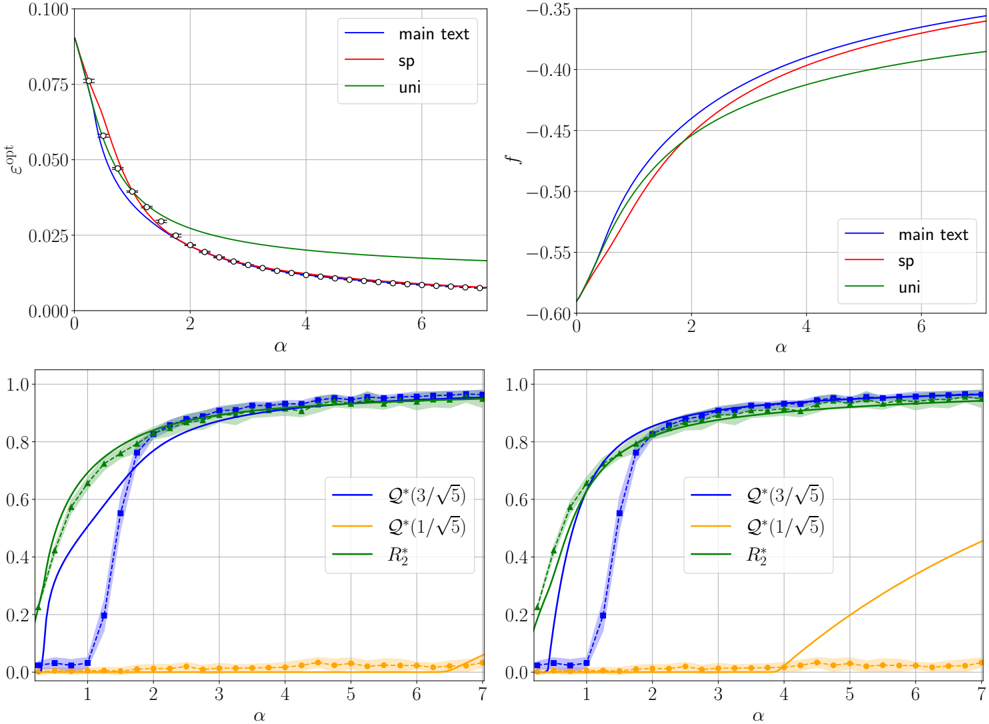
The image presents four line charts arranged in a 2x2 grid, comparing the performance of different algorithms across a range of alpha values. The top-left chart displays epsilon-opt values, the top-right chart displays 'f' values, and the bottom two charts display performance metrics Q*(3/√5), Q*(1/√5), and R*_2. The bottom two charts appear to be variations of the same data, possibly representing different experimental conditions or perspectives.
### Components/Axes
**Top-Left Chart:**
* **Title:** Implicit, represents epsilon-opt values.
* **X-axis:** α (Alpha), ranging from 0 to 7.
* **Y-axis:** ε^opt, ranging from 0.000 to 0.100, with increments of 0.025.
* **Legend (Top-Right):**
* Blue line: "main text"
* Red line: "sp"
* Green line: "uni"
**Top-Right Chart:**
* **Title:** Implicit, represents 'f' values.
* **X-axis:** α (Alpha), ranging from 0 to 6.
* **Y-axis:** f, ranging from -0.60 to -0.35, with increments of 0.05.
* **Legend (Bottom-Right):**
* Blue line: "main text"
* Red line: "sp"
* Green line: "uni"
**Bottom-Left Chart:**
* **Title:** Implicit, represents performance metrics.
* **X-axis:** α (Alpha), ranging from 0 to 7.
* **Y-axis:** Values ranging from 0.0 to 1.0, with increments of 0.2.
* **Legend (Right):**
* Blue line: "Q*(3/√5)"
* Orange line: "Q*(1/√5)"
* Green line: "R*_2"
**Bottom-Right Chart:**
* **Title:** Implicit, represents performance metrics.
* **X-axis:** α (Alpha), ranging from 0 to 7.
* **Y-axis:** Values ranging from 0.0 to 1.0, with increments of 0.2.
* **Legend (Right):**
* Blue line: "Q*(3/√5)"
* Orange line: "Q*(1/√5)"
* Green line: "R*_2"
### Detailed Analysis
**Top-Left Chart (ε^opt vs. α):**
* **"main text" (Blue):** Starts at approximately 0.05, decreases rapidly, and plateaus around 0.01 after α = 2.
* α = 0: ε^opt ≈ 0.05
* α = 2: ε^opt ≈ 0.015
* α = 6: ε^opt ≈ 0.01
* **"sp" (Red):** Starts at approximately 0.08, decreases rapidly, and plateaus around 0.01 after α = 2.
* α = 0: ε^opt ≈ 0.08
* α = 2: ε^opt ≈ 0.015
* α = 6: ε^opt ≈ 0.01
* **"uni" (Green):** Starts at approximately 0.08, decreases gradually, and plateaus around 0.02 after α = 4.
* α = 0: ε^opt ≈ 0.08
* α = 2: ε^opt ≈ 0.03
* α = 6: ε^opt ≈ 0.02
**Top-Right Chart (f vs. α):**
* **"main text" (Blue):** Starts at approximately -0.60, increases rapidly, and plateaus around -0.38 after α = 4.
* α = 0: f ≈ -0.60
* α = 2: f ≈ -0.45
* α = 6: f ≈ -0.38
* **"sp" (Red):** Starts at approximately -0.60, increases rapidly, and plateaus around -0.40 after α = 4.
* α = 0: f ≈ -0.60
* α = 2: f ≈ -0.47
* α = 6: f ≈ -0.40
* **"uni" (Green):** Starts at approximately -0.60, increases rapidly, and plateaus around -0.42 after α = 4.
* α = 0: f ≈ -0.60
* α = 2: f ≈ -0.49
* α = 6: f ≈ -0.42
**Bottom-Left Chart (Performance Metrics vs. α):**
* **"Q*(3/√5)" (Blue):** Starts at approximately 0.0, jumps to approximately 0.8 at α = 1, and plateaus around 0.95 after α = 3.
* α = 0: Value ≈ 0.0
* α = 1: Value ≈ 0.8
* α = 3: Value ≈ 0.95
* α = 7: Value ≈ 0.95
* **"Q*(1/√5)" (Orange):** Remains near 0.0 across all alpha values.
* α = 0: Value ≈ 0.0
* α = 7: Value ≈ 0.0
* **"R*_2" (Green):** Starts at approximately 0.2, increases rapidly, and plateaus around 0.95 after α = 3.
* α = 0: Value ≈ 0.2
* α = 2: Value ≈ 0.8
* α = 3: Value ≈ 0.95
* α = 7: Value ≈ 0.95
**Bottom-Right Chart (Performance Metrics vs. α):**
* **"Q*(3/√5)" (Blue):** Starts at approximately 0.0, jumps to approximately 0.8 at α = 1, and plateaus around 0.95 after α = 3.
* α = 0: Value ≈ 0.0
* α = 1: Value ≈ 0.8
* α = 3: Value ≈ 0.95
* α = 7: Value ≈ 0.95
* **"Q*(1/√5)" (Orange):** Starts at approximately 0.0, increases gradually, reaching approximately 0.45 at α = 7.
* α = 0: Value ≈ 0.0
* α = 7: Value ≈ 0.45
* **"R*_2" (Green):** Starts at approximately 0.2, increases rapidly, and plateaus around 0.95 after α = 3.
* α = 0: Value ≈ 0.2
* α = 2: Value ≈ 0.8
* α = 3: Value ≈ 0.95
* α = 7: Value ≈ 0.95
### Key Observations
* In the top-left chart, "main text" and "sp" algorithms have similar performance, achieving lower epsilon-opt values compared to "uni" as alpha increases.
* In the top-right chart, all three algorithms ("main text", "sp", and "uni") converge to similar 'f' values as alpha increases.
* In the bottom-left chart, "Q*(3/√5)" and "R*_2" metrics show a significant jump in performance around α = 1, while "Q*(1/√5)" remains consistently low.
* In the bottom-right chart, "Q*(3/√5)" and "R*_2" metrics show a significant jump in performance around α = 1, while "Q*(1/√5)" increases gradually.
* The bottom-left and bottom-right charts differ primarily in the behavior of the "Q*(1/√5)" metric, which remains near zero in the bottom-left chart but increases gradually in the bottom-right chart.
### Interpretation
The charts provide a comparative analysis of different algorithms ("main text", "sp", and "uni") and their performance metrics ("Q*(3/√5)", "Q*(1/√5)", and "R*_2") across varying alpha values. The top charts suggest that "main text" and "sp" algorithms are more effective in minimizing epsilon-opt compared to "uni". The bottom charts indicate that "Q*(3/√5)" and "R*_2" metrics exhibit a threshold behavior, with a significant performance jump around α = 1. The difference in "Q*(1/√5)" behavior between the bottom-left and bottom-right charts suggests that this metric is sensitive to specific experimental conditions or parameter settings. The data suggests that the choice of algorithm and alpha value significantly impacts performance, and the optimal configuration depends on the specific metric being optimized.