## Diagram: Lambda Calculus Beta Reduction
### Overview
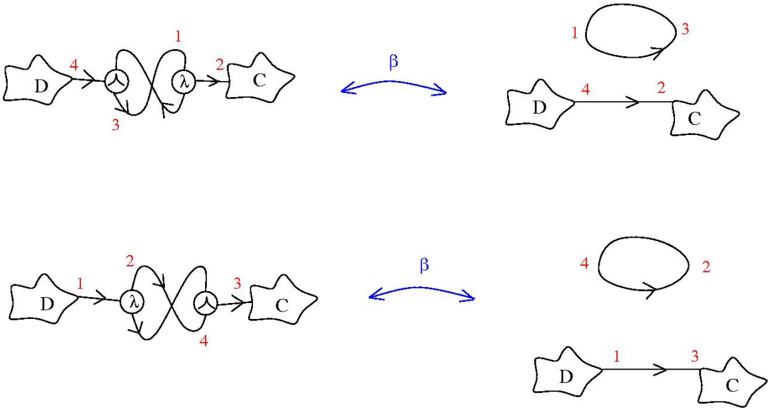
The image depicts two examples of beta reduction in lambda calculus, shown as transformations between two states. Each example consists of a diagram on the left side, a blue double-headed arrow labeled "β" in the center, and a transformed diagram on the right side. The diagrams involve nodes labeled "D" and "C", lambda abstractions (λ), and directed edges labeled with numbers 1, 2, 3, and 4.
### Components/Axes
* **Nodes:**
* "D": Represents a data term.
* "C": Represents a computation term.
* "λ": Represents a lambda abstraction.
* **Edges:** Directed edges represent function application or data flow. They are labeled with numbers 1, 2, 3, and 4, indicating the order or association of the terms.
* **Transformation Arrow:** A blue double-headed arrow labeled "β" indicates the beta reduction step.
* **Labels:** The labels "D", "C", "λ", "β", and the numbers 1-4 are in black or blue (for β) and red respectively.
### Detailed Analysis
**Top Example:**
* **Left Side:**
* Node "D" has an outgoing edge labeled "4" pointing to a node with a small downward-pointing triangle.
* The triangle node has outgoing edge labeled "1" and incoming edge labeled "3" both connecting to a lambda abstraction node "λ".
* The lambda abstraction node "λ" has an outgoing edge labeled "2" pointing to node "C".
* The lambda abstraction node "λ" also has an outgoing edge labeled "1" that loops back to itself.
* The triangle node also has an outgoing edge labeled "3" that loops back to itself.
* **Transformation:** Beta reduction (β).
* **Right Side:**
* A loop with an arrow and labels "1" and "3".
* Node "D" has an outgoing edge labeled "4" pointing to node "C", which has an outgoing edge labeled "2".
**Bottom Example:**
* **Left Side:**
* Node "D" has an outgoing edge labeled "1" pointing to a lambda abstraction node "λ".
* The lambda abstraction node "λ" has an outgoing edge labeled "2" that loops back to itself.
* The lambda abstraction node "λ" has an outgoing edge that crosses over to a node with a small downward-pointing triangle, which has an outgoing edge labeled "3" pointing to node "C".
* The triangle node has an outgoing edge labeled "4" that loops back to itself.
* **Transformation:** Beta reduction (β).
* **Right Side:**
* A loop with an arrow and labels "4" and "2".
* Node "D" has an outgoing edge labeled "1" pointing to node "C", which has an outgoing edge labeled "3".
### Key Observations
* The diagrams illustrate how beta reduction simplifies lambda expressions by substituting the argument of a function into its body.
* The numbered edges indicate the flow of data or the association of terms during the reduction process.
* The lambda abstraction nodes "λ" disappear after the beta reduction, and the connections are rearranged.
* The loops on the right side of the top example are labeled "1" and "3", while the loops on the right side of the bottom example are labeled "4" and "2".
### Interpretation
The image provides a visual representation of beta reduction, a fundamental operation in lambda calculus. It demonstrates how complex expressions involving lambda abstractions can be simplified into equivalent, more direct forms. The numbered edges help track the flow of data and the relationships between terms during the reduction process. The two examples show different configurations of lambda expressions and their corresponding reduced forms, highlighting the versatility of beta reduction in simplifying various lambda calculus expressions. The loops that appear after the beta reduction represent self-application or recursion.