## Line Charts: Evolution of $\epsilon$ over Time for varying $K_s$
### Overview
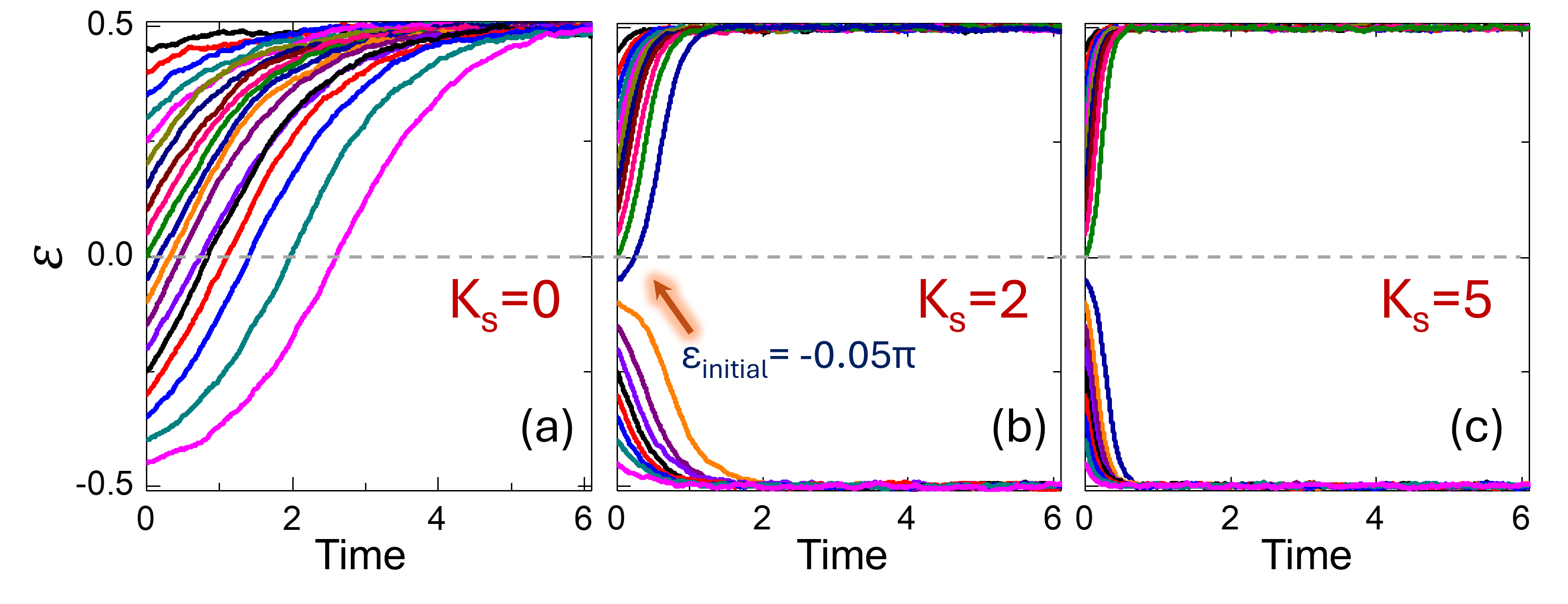
The image displays three side-by-side line charts, labeled (a), (b), and (c), illustrating the temporal evolution of a variable $\epsilon$ (epsilon) over time. Each chart represents the system's behavior under a different parameter value, $K_s$. The charts demonstrate a transition in system dynamics as $K_s$ increases, moving from a single-attractor state to a bistable state with rapid convergence.
### Components/Axes
* **Y-Axis:** Labeled "$\epsilon$". The scale ranges from -0.5 to 0.5. A dashed horizontal line is drawn at $\epsilon = 0.0$ across all three panels.
* **X-Axis:** Labeled "Time". The scale ranges from 0 to 6.
* **Panel (a):** Located on the left. Contains the label "$K_s=0$" in red text in the bottom-right quadrant.
* **Panel (b):** Located in the center. Contains the label "$K_s=2$" in red text in the bottom-right quadrant. It includes an annotation: "$\epsilon_{initial} = -0.05\pi$" written in blue text, with an orange arrow pointing toward the cluster of lines starting below the zero line.
* **Panel (c):** Located on the right. Contains the label "$K_s=5$" in red text in the bottom-right quadrant.
### Detailed Analysis
#### Panel (a) [$K_s=0$]
* **Trend:** All colored trajectories exhibit an upward slope.
* **Behavior:** Regardless of the starting position (which varies between -0.5 and 0.5), all trajectories converge toward the upper steady state of $\epsilon = 0.5$.
* **Convergence Rate:** The convergence is gradual, with most lines reaching the steady state between time $t=2$ and $t=6$.
#### Panel (b) [$K_s=2$]
* **Trend:** The system exhibits bifurcation. Trajectories starting above the zero line trend upward to 0.5; trajectories starting below the zero line trend downward to -0.5.
* **Annotation:** The text "$\epsilon_{initial} = -0.05\pi$" (blue) with an orange arrow indicates the starting condition for the group of trajectories that converge to the negative steady state.
* **Convergence Rate:** The convergence is significantly faster than in panel (a), with most trajectories reaching their respective steady states by $t=1$.
#### Panel (c) [$K_s=5$]
* **Trend:** Similar to panel (b), the system is bistable, with trajectories splitting toward 0.5 or -0.5.
* **Convergence Rate:** The convergence is extremely rapid. The trajectories appear almost vertical, reaching their steady states almost immediately after $t=0$.
### Key Observations
* **Bistability Transition:** As $K_s$ increases from 0 to 2, the system transitions from a single-attractor state (where all values converge to 0.5) to a bistable state (where values converge to either 0.5 or -0.5 depending on initial conditions).
* **Coupling Strength:** The parameter $K_s$ appears to act as a coupling strength or control parameter. Higher values of $K_s$ result in steeper, faster convergence to the steady states.
* **Symmetry:** The system shows symmetry around the $\epsilon=0$ axis in panels (b) and (c), suggesting that the basins of attraction for the positive and negative states are balanced.
### Interpretation
The data suggests this is a visualization of a dynamical system, likely related to synchronization or phase-locking (such as the Kuramoto model or a similar oscillator network).
* **At $K_s=0$:** The system lacks the coupling strength required to maintain a negative state, causing all trajectories to be "pulled" toward the positive attractor at 0.5.
* **At $K_s \ge 2$:** The coupling strength is sufficient to create two distinct basins of attraction. The system becomes sensitive to initial conditions; if a trajectory starts below the threshold (indicated by the $\epsilon_{initial}$ annotation), it is captured by the negative attractor (-0.5). If it starts above, it is captured by the positive attractor (0.5).
* **The Role of $K_s$:** The increase in $K_s$ effectively "sharpens" the potential landscape of the system, making the steady states more stable and the transition to them more aggressive. The annotation $\epsilon_{initial} = -0.05\pi$ highlights the specific starting condition required to enter the negative basin of attraction.