\n
## Diagram: LLM Fine-tuning and Subtask Decomposition
### Overview
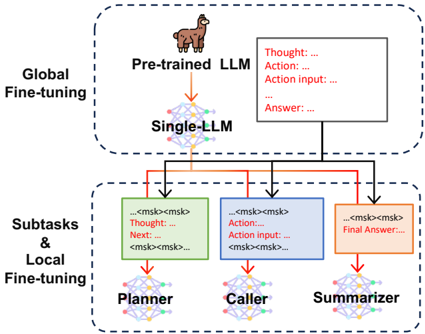
The image is a diagram illustrating a process of fine-tuning a Large Language Model (LLM) and decomposing tasks into subtasks handled by specialized modules. It depicts a two-stage process: Global Fine-tuning and Subtasks & Local Fine-tuning. The diagram uses a network-like structure with arrows indicating the flow of information.
### Components/Axes
The diagram is divided into two main sections, visually separated by dashed blue rectangles:
* **Global Fine-tuning:** Located at the top of the image.
* **Subtasks & Local Fine-tuning:** Located at the bottom of the image.
Key components within these sections include:
* **Pre-trained LLM:** Represented by a llama icon and the text "Pre-trained LLM".
* **Single-LLM:** A network-like structure representing the LLM after global fine-tuning.
* **Planner:** A network-like structure with a green box containing text "...<msk><msk> Thought: ... Next: ...<msk>".
* **Caller:** A network-like structure with a blue box containing text "...<msk><msk> Action: ... Action input: ...<msk>".
* **Summarizer:** A network-like structure with an orange box containing text "...<msk><msk> Final Answer: ...".
* **Thought/Action/Answer:** A white box with red text "Thought: ...", blue text "Action: ...", and red text "Action input: ...", and red text "Answer: ...".
Arrows indicate the flow of information between these components.
### Detailed Analysis or Content Details
The diagram shows the following flow:
1. **Pre-trained LLM to Single-LLM:** A red arrow points from the llama icon (Pre-trained LLM) to the "Single-LLM" network.
2. **Single-LLM to Subtask Modules:** Three arrows originate from the "Single-LLM" network:
* A red arrow points to the "Planner".
* An orange arrow points to the "Caller".
* A blue arrow points to the "Summarizer".
3. **Subtask Modules:** Each subtask module (Planner, Caller, Summarizer) is a network-like structure.
* The "Planner" contains the text "...<msk><msk> Thought: ... Next: ...<msk>".
* The "Caller" contains the text "...<msk><msk> Action: ... Action input: ...<msk>".
* The "Summarizer" contains the text "...<msk><msk> Final Answer: ...".
4. **Single-LLM to Thought/Action/Answer:** A white box with red text "Thought: ...", blue text "Action: ...", and red text "Action input: ...", and red text "Answer: ..." is connected to the "Single-LLM" network.
The text "<msk><msk>" appears repeatedly within the subtask modules, likely representing masked tokens or placeholders.
### Key Observations
* The diagram highlights a two-stage fine-tuning process.
* The "Single-LLM" acts as a central hub, distributing tasks to specialized modules.
* Each subtask module focuses on a specific aspect of the overall task (planning, action execution, summarization).
* The use of "<msk><msk>" suggests a focus on token manipulation or generation.
### Interpretation
The diagram illustrates a method for improving LLM performance by combining global fine-tuning with task decomposition. The initial "Global Fine-tuning" stage prepares the LLM for a broader range of tasks. Subsequently, "Subtasks & Local Fine-tuning" breaks down complex tasks into smaller, more manageable subtasks, each handled by a specialized module. This approach allows for more targeted fine-tuning and potentially improves the accuracy and efficiency of the LLM. The llama icon likely represents a specific LLM architecture. The use of masked tokens suggests a focus on generative modeling or sequence-to-sequence tasks. The diagram suggests a modular approach to LLM development, where different modules can be trained and optimized independently. The flow of information from the "Single-LLM" to the subtask modules indicates that the LLM acts as a coordinator, directing the overall process. The diagram does not provide any quantitative data or performance metrics. It is a conceptual illustration of a system architecture.