## Bar Chart: Performance Comparison of R1-distilled and RRM Models
### Overview
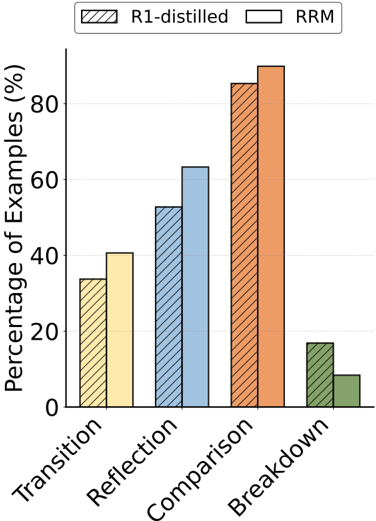
The image is a grouped bar chart comparing the performance of two models, **R1-distilled** (striped pattern) and **RRM** (solid color), across four categories: **Transition**, **Reflection**, **Comparison**, and **Breakdown**. The y-axis represents the **Percentage of Examples (%)**, ranging from 0% to 100%. Each category contains two bars, one for each model, with approximate values extracted from the chart.
### Components/Axes
- **X-axis (Categories)**:
- Transition
- Reflection
- Comparison
- Breakdown
- **Y-axis (Values)**:
- Percentage of Examples (%) from 0% to 100% in 20% increments.
- **Legend**:
- **R1-distilled**: Striped pattern (orange).
- **RRM**: Solid color (blue).
- **Legend Position**: Top-right corner of the chart.
### Detailed Analysis
1. **Transition**:
- R1-distilled: ~35% (striped orange bar).
- RRM: ~40% (solid blue bar).
2. **Reflection**:
- R1-distilled: ~50% (striped orange bar).
- RRM: ~60% (solid blue bar).
3. **Comparison**:
- R1-distilled: ~85% (striped orange bar).
- RRM: ~90% (solid blue bar).
4. **Breakdown**:
- R1-distilled: ~15% (striped orange bar).
- RRM: ~10% (solid blue bar).
### Key Observations
- **RRM outperforms R1-distilled** in **Reflection** (+10%) and **Comparison** (+5%).
- **R1-distilled** has a slight edge in **Breakdown** (+5%).
- **Comparison** is the highest-performing category for both models, with RRM achieving ~90%.
- **Breakdown** is the lowest-performing category for both models, with RRM at ~10%.
### Interpretation
The data suggests that **RRM** is more effective in **Reflection** and **Comparison** tasks, likely due to its ability to handle complex reasoning or contextual analysis. **R1-distilled** performs better in **Breakdown** scenarios, possibly indicating a focus on simpler or more structured tasks. The stark contrast in **Comparison** (85% vs. 90%) highlights RRM's superior capability in synthesizing or evaluating information. The **Breakdown** anomaly may reflect differences in training data or model architecture, warranting further investigation into why R1-distilled excels here. Overall, RRM demonstrates broader utility across most categories, while R1-distilled has niche strengths.