## Diagram: Automated Theorem Proving System Architecture
### Overview
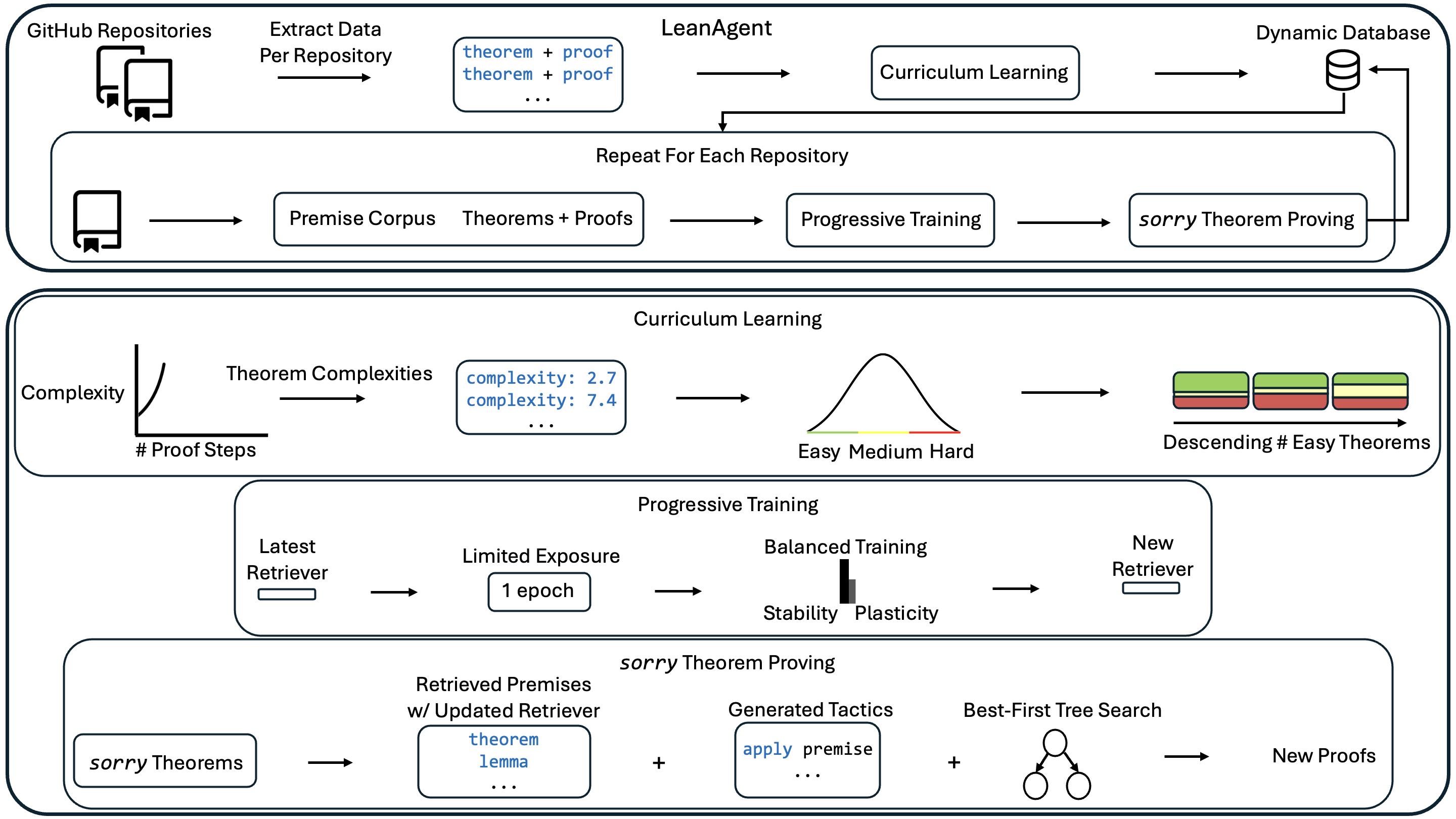
The diagram illustrates a multi-stage automated theorem proving system with iterative learning and curriculum adaptation. It shows data flow from GitHub repositories through a LeanAgent, curriculum learning framework, progressive training mechanisms, and specialized handling of "SORRY Theorems" (theorems that initially fail to prove).
### Components/Axes
**Key Components:**
1. **Input Layer**
- GitHub Repositories (source of theorems/proofs)
- Extract Data Per Repository → Premise Corpus + Theorems + Proofs
2. **Core Processing**
- LeanAgent (theorem proving engine)
- Curriculum Learning (complexity-based adaptation)
- Progressive Training (retriever evolution)
3. **Output Layer**
- Dynamic Database (knowledge repository)
- SORRY Theorem Proving (specialized handling)
**Visual Elements:**
- Color-coded complexity levels (green=low, yellow=medium, red=high)
- Feedback loops between components
- Iterative refinement arrows
### Detailed Analysis
**1. Data Ingestion Pipeline**
- GitHub repositories → Extract Data Per Repository
- Creates: Premise Corpus + Theorems + Proofs
**2. Curriculum Learning System**
- Complexity → Theorem Complexities (e.g., 2.7, 7.4)
- Complexity graph shows:
- # Proof Steps vs Complexity
- Distribution: Easy (green) → Medium (yellow) → Hard (red)
- Descending # Easy Theorems over time
**3. Progressive Training Mechanism**
- Latest Retriever → Limited Exposure (1 epoch)
- Balanced Training (Stability vs Plasticity)
- New Retriever generation
**4. SORRY Theorem Proving**
- Input: SORRY Theorems
- Process:
- Retrieved Premises (updated retriever)
- Generated Tactics
- Best-First Tree Search
- Output: New Proofs
### Key Observations
1. **Iterative Learning**: Feedback loops between components suggest continuous improvement
2. **Complexity Adaptation**: Curriculum learning adjusts difficulty based on proof complexity metrics
3. **Retriever Evolution**: Progressive training creates increasingly sophisticated theorem retrieval systems
4. **Specialized Handling**: SORRY Theorems use distinct processing pipeline with retrieval-augmented generation
### Interpretation
This architecture demonstrates a sophisticated approach to automated theorem proving that:
1. **Adapts Difficulty**: Uses complexity metrics to create personalized learning paths
2. **Balances Stability/Plasticity**: Progressive training maintains core knowledge while enabling adaptation
3. **Handles Edge Cases**: Specialized SORRY Theorem Proving addresses previously unsolved problems
4. **Leverages Community Knowledge**: GitHub repositories serve as initial knowledge base
The system appears designed to create self-improving theorem provers that can handle increasingly complex mathematical problems through iterative learning and curriculum adaptation. The "SORRY Theorem" handling suggests a focus on solving previously intractable problems through advanced retrieval and search strategies.