TECHNICAL ASSET FINGERPRINT
f49020e403e56bc433c93c00
Click to view fullscreen
Press ESC or click to close
FOUND IN PAPERS
EXPERT: gemini-2.5-flash-lite-free VERSION 1
RUNTIME: google-free/gemini-2.5-flash-lite
INTEL_VERIFIED
## Diagram: Knowledge Graph Question Answering System
### Overview
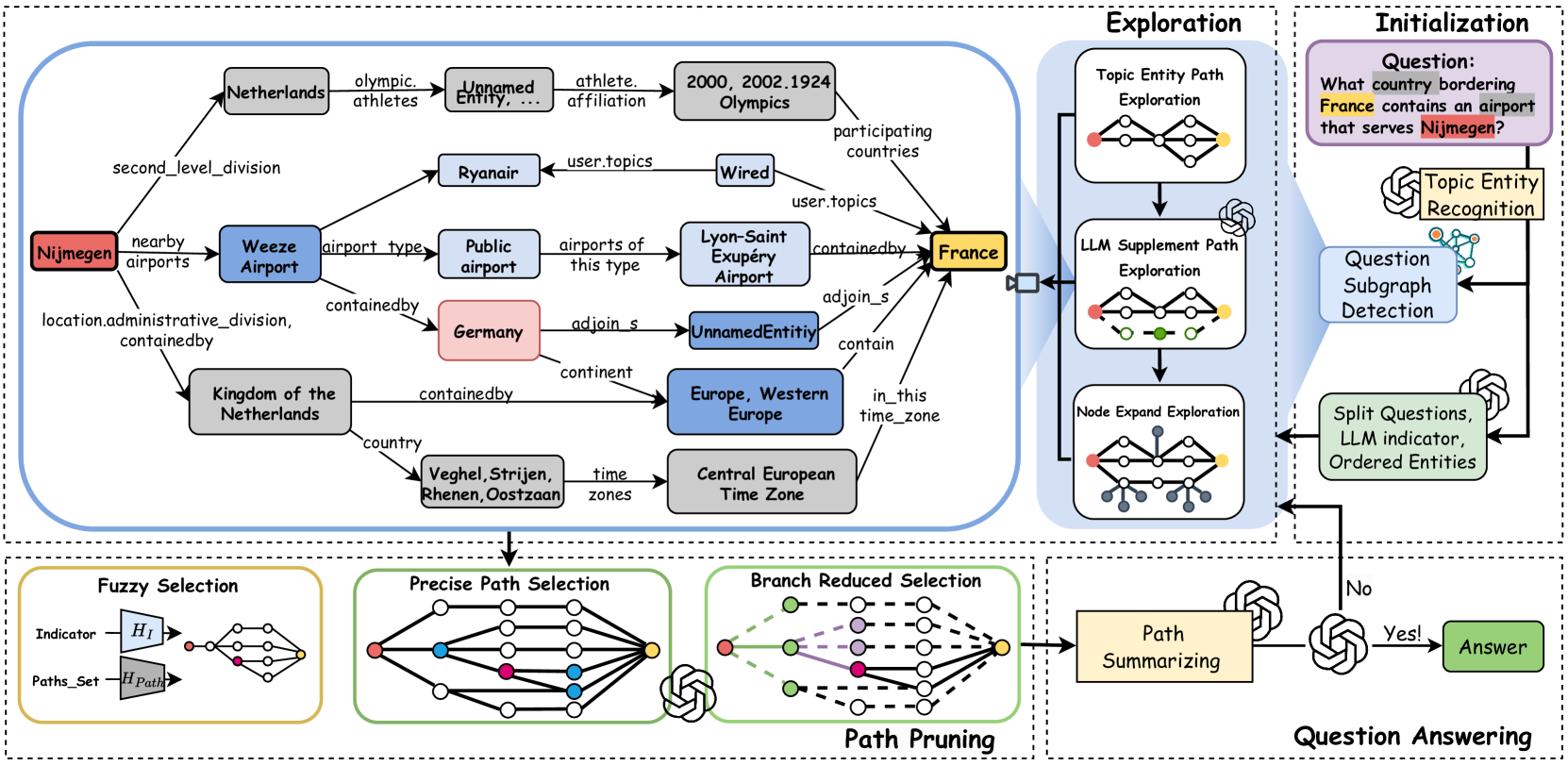
This diagram illustrates a system designed to answer questions by leveraging a knowledge graph. The system comprises three main stages: Initialization, Exploration, and Question Answering. The Initialization stage processes the input question to identify key entities and structure. The Exploration stage navigates and expands paths within the knowledge graph based on the identified entities. Finally, the Question Answering stage prunes and summarizes the explored paths to generate an answer.
### Components/Axes
The diagram is structured into distinct sections with labels and visual cues indicating flow and relationships.
**Main Knowledge Graph Section (Top-Left):**
This section depicts a knowledge graph with entities represented by nodes and relationships by directed edges.
* **Entities (Nodes):**
* **Red:** Nijmegen, Germany
* **Blue:** Weeze Airport, Public airport, Lyon-Saint Exupéry Airport, Europe, Western Europe
* **Gray:** Netherlands, Unnamed Entity, ..., 2000, 2002, 1924 Olympics, Kingdom of the Netherlands, Veghel, Strijen, Rhenen, Oostzaan, Central European Time Zone
* **Yellow:** France
* **White:** UnnamedEntity (appears twice)
* **Orange:** Ryanair, Wired
* **Relationships (Edges/Labels):**
* `second_level_division` (Netherlands -> Nijmegen)
* `nearby` (Nijmegen -> Weeze Airport)
* `location.administrative_division, containedby` (Nijmegen -> Kingdom of the Netherlands)
* `airport type` (Weeze Airport -> Public airport)
* `containedby` (Weeze Airport -> Germany)
* `containedby` (Kingdom of the Netherlands -> Europe, Western Europe)
* `country` (Kingdom of the Netherlands -> Veghel, Strijen, Rhenen, Oostzaan)
* `continent` (Germany -> Europe, Western Europe)
* `time zones` (Veghel, Strijen, Rhenen, Oostzaan -> Central European Time Zone)
* `user.topics` (Ryanair -> Wired)
* `airports of this type` (Public airport -> Lyon-Saint Exupéry Airport)
* `containedby` (Lyon-Saint Exupéry Airport -> France)
* `adjoin_s` (Germany -> UnnamedEntity)
* `contain` (UnnamedEntity -> France)
* `in_this_time_zone` (Europe, Western Europe -> Central European Time Zone)
* `participating countries` (2000, 2002, 1924 Olympics -> France)
* `athlete. affiliation` (Unnamed Entity, ... -> 2000, 2002, 1924 Olympics)
* `olympic. athletes` (Netherlands -> Unnamed Entity, ...)
**Initialization Section (Top-Right):**
This section outlines the initial steps of processing a question.
* **Question Box (Purple):** Contains the example question: "What country bordering France contains an airport that serves Nijmegen?"
* **Topic Entity Recognition (Yellow Box):** A process step.
* **Question Subgraph Detection (Light Blue Box):** A process step, visually represented by a small graph.
* **Split Questions, LLM indicator, Ordered Entities (Green Box):** A process step, indicated by a stylized "G" logo (likely representing a Large Language Model).
**Exploration Section (Middle-Right):**
This section details different path exploration strategies within the knowledge graph. Each sub-section shows a simplified graph representation with nodes colored red, green, blue, and yellow, indicating different stages or types of nodes.
* **Topic Entity Path Exploration:** Shows an initial path exploration.
* **LLM Supplement Path Exploration:** Shows an expanded path exploration, with additional green nodes.
* **Node Expand Exploration:** Shows further expansion of paths with more gray nodes.
**Question Answering Section (Bottom):**
This section describes the final stages of generating an answer.
* **Fuzzy Selection (Yellow Box):** Takes an `Indicator` (H_I) and `Paths_Set` (H_Path) as input and produces a simplified graph.
* **Precise Path Selection (Green Box):** Takes multiple paths and selects a subset, visualized as a branching structure.
* **Branch Reduced Selection (Green Box):** Further refines the selected paths.
* **Path Pruning (Label below Precise/Branch Reduced):** A general label for the selection processes.
* **Path Summarizing (Yellow Box):** Takes the pruned paths and summarizes them.
* **Decision Point (Stylized "G" logo):** Represents a decision based on the summarized path.
* **"No" branch:** Leads back to the "Split Questions, LLM indicator, Ordered Entities" step.
* **"Yes!" branch:** Leads to the "Answer" box.
* **Answer Box (Green):** The final output.
### Detailed Analysis or Content Details
**Knowledge Graph Structure:**
The knowledge graph connects various entities related to geography, transportation, and events.
* **Nijmegen** is a location that has `nearby` airports, specifically **Weeze Airport**.
* **Weeze Airport** is a `Public airport` and is `containedby` **Germany**.
* **Germany** is on the `continent` of **Europe, Western Europe**.
* **Nijmegen** is also `location.administrative_division, containedby` the **Kingdom of the Netherlands**.
* The **Kingdom of the Netherlands** is a `country` within **Europe, Western Europe**.
* **Veghel, Strijen, Rhenen, Oostzaan** are locations within the **Kingdom of the Netherlands** and are associated with `time zones` that fall under the **Central European Time Zone**.
* **Ryanair** is an airline that has `user.topics` related to **Wired**.
* **Public airports** are of the type that includes **Lyon-Saint Exupéry Airport**.
* **Lyon-Saint Exupéry Airport** is `containedby` **France**.
* **Germany** `adjoin_s` an `UnnamedEntity`, which `contain`s **France**.
* **Europe, Western Europe** is `in_this_time_zone` as the **Central European Time Zone**.
* The **Netherlands** has `olympic. athletes` associated with an `Unnamed Entity, ...`, which has an `athlete. affiliation` with the **2000, 2002, 1924 Olympics**.
* The **2000, 2002, 1924 Olympics** had `participating countries` including **France**.
**Question Answering Flow:**
1. **Initialization:** The question "What country bordering France contains an airport that serves Nijmegen?" is processed. `Topic Entity Recognition` identifies "France" and "Nijmegen". `Question Subgraph Detection` likely extracts a subgraph relevant to these entities and their relationships. The output is `Split Questions, LLM indicator, Ordered Entities`.
2. **Exploration:** The system performs path exploration in the knowledge graph.
* `Topic Entity Path Exploration` finds initial paths.
* `LLM Supplement Path Exploration` uses an LLM to find additional relevant paths.
* `Node Expand Exploration` further expands these paths.
3. **Question Answering:**
* `Fuzzy Selection` and `Precise Path Selection` (including `Branch Reduced Selection` and `Path Pruning`) are applied to filter and refine the explored paths.
* `Path Summarizing` condenses the relevant paths into a concise representation.
* A final decision is made (likely by an LLM, indicated by the "G" logo). If the summarized path leads to a valid answer ("Yes!"), the `Answer` is generated. If not ("No"), the process might loop back to refine the question or exploration.
### Key Observations
* The system aims to answer complex relational questions by traversing a knowledge graph.
* It utilizes different exploration strategies, including LLM-assisted path finding, to cover potential answer paths.
* A multi-stage pruning and selection process is employed to refine the relevant information from the explored paths.
* The example question demonstrates a query requiring the identification of a country bordering France that has an airport serving Nijmegen. This implies a need to connect Nijmegen to its airports, identify the country of those airports, and then check for adjacency to France.
* The use of different colored nodes in the exploration diagrams suggests a hierarchical or type-based distinction of entities or path segments during exploration.
### Interpretation
This diagram outlines a sophisticated question-answering system that bridges natural language queries with structured knowledge graph data. The system's strength lies in its ability to decompose a complex question into manageable steps: identifying key entities, exploring relevant connections within the knowledge graph using both structured and LLM-based methods, and then rigorously filtering and summarizing these connections to arrive at a precise answer.
The `Initialization` phase highlights the critical role of Natural Language Processing (NLP) and Large Language Models (LLMs) in understanding the user's intent and extracting the core components of the question. The `Exploration` phase demonstrates a systematic approach to graph traversal, where multiple strategies are employed to ensure comprehensive coverage of potential answer paths. The inclusion of "LLM Supplement Path Exploration" suggests an adaptive system that can leverage the generative capabilities of LLMs to discover relationships not explicitly encoded in traditional graph traversal algorithms.
The `Question Answering` section, particularly `Path Pruning` and `Path Summarizing`, indicates a focus on efficiency and accuracy. By reducing the number of paths and then distilling them, the system aims to avoid information overload and present a clear, concise answer. The feedback loop ("No" branch) suggests an iterative refinement process, allowing the system to re-evaluate or re-query if an initial answer is not satisfactory or if the exploration was insufficient.
Ultimately, this system represents a hybrid approach, combining symbolic reasoning (knowledge graph traversal) with sub-symbolic reasoning (LLM integration) to tackle complex question-answering tasks. The example question, "What country bordering France contains an airport that serves Nijmegen?", is a good test case for such a system, requiring multi-hop reasoning and the integration of geographical and transportation-related information. The system's design suggests it can handle queries that involve identifying entities, their attributes, and their relationships across multiple levels of abstraction within the knowledge graph.
DECODING INTELLIGENCE...