## Flowchart: NEMESYS System Architecture
### Overview
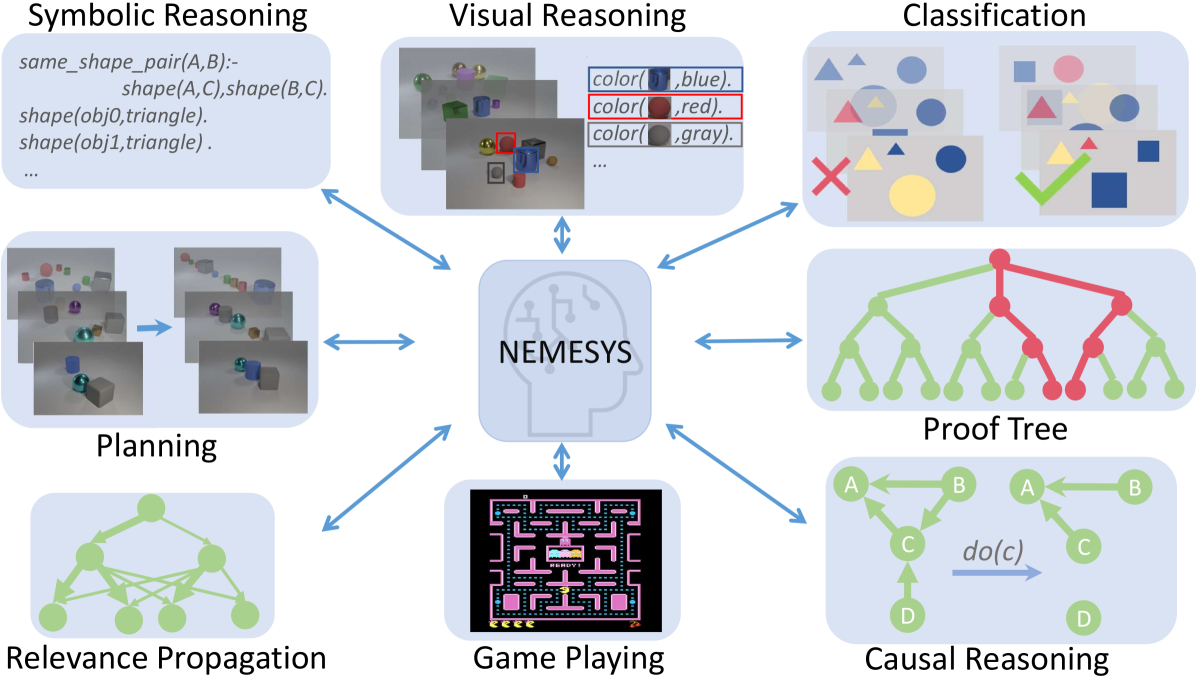
The image depicts a conceptual architecture of a system called NEMESYS, integrating multiple reasoning modalities. The central "NEMESYS" box connects to eight peripheral components through bidirectional arrows, representing information flow. The system combines symbolic, visual, and causal reasoning with game-playing capabilities.
### Components/Axes
1. **Central Node**:
- Label: "NEMESYS" (stylized with a brain icon)
- Position: Center of the diagram
2. **Peripheral Components** (clockwise from top-left):
- **Symbolic Reasoning**:
- Contains code snippets about shape relationships
- Example: `same_shape_pair(A,B): shape(A,C), shape(B,C), shape(obj0, triangle)`
- **Visual Reasoning**:
- Color coding legend:
- Blue (□), Red (■), Gray (■)
- Contains image examples with colored objects
- **Classification**:
- Shape examples with checkmarks (✓) and crosses (✗)
- Includes geometric shapes (triangle, circle, square)
- **Planning**:
- Shows grid-based planning examples
- **Relevance Propagation**:
- Network diagram with interconnected nodes
- **Game Playing**:
- Maze-like game environment with pink/purple elements
- **Proof Tree**:
- Hierarchical tree structure with green/red nodes
- **Causal Reasoning**:
- Graph with nodes A-D and causal relationships (→, do(c))
### Detailed Analysis
- **Symbolic Reasoning**:
- Text-based logic rules for object relationships
- Uses predicate logic notation (e.g., `shape(obj1, triangle)`)
- **Visual Reasoning**:
- Color-coded object recognition system
- Three distinct color categories with specific shapes
- **Classification**:
- Binary classification system (correct/incorrect)
- Uses geometric shape recognition
- **Planning**:
- Grid-based navigation examples
- Shows pathfinding scenarios
- **Relevance Propagation**:
- Network topology visualization
- Represents information flow efficiency
- **Game Playing**:
- Maze environment with colored obstacles
- Suggests reinforcement learning application
- **Proof Tree**:
- Binary decision tree structure
- Nodes labeled A-D with hierarchical relationships
- **Causal Reasoning**:
- Causal graph with intervention notation (do(c))
- Shows cause-effect relationships between nodes
### Key Observations
1. Bidirectional arrows between NEMESYS and all components indicate integrated processing
2. Color-coded elements appear in both Visual Reasoning and Classification components
3. Game Playing component uses similar color scheme (pink/purple) to Visual Reasoning's red
4. Proof Tree and Causal Reasoning components share node labeling convention (A-D)
5. System combines deductive (Proof Tree) and inductive (Classification) reasoning
### Interpretation
The NEMESYS architecture demonstrates a multi-modal AI system that:
1. Processes symbolic logic (Symbolic Reasoning)
2. Interprets visual information (Visual Reasoning)
3. Makes classifications (Classification)
4. Plans actions (Planning)
5. Maintains relevance in information processing (Relevance Propagation)
6. Engages in game-like environments (Game Playing)
7. Constructs logical proofs (Proof Tree)
8. Understands causal relationships (Causal Reasoning)
The bidirectional connections suggest an integrated system where different reasoning modalities inform each other. The presence of both proof trees and causal graphs indicates the system can handle both deductive and probabilistic reasoning. The game-playing component implies potential applications in reinforcement learning scenarios, while the planning module suggests capability in strategic decision-making.
The color coding consistency between Visual Reasoning and Game Playing components might indicate shared visual processing capabilities. The system's complexity suggests it could be used for advanced AI applications requiring multiple reasoning modalities, such as robotics or complex decision support systems.