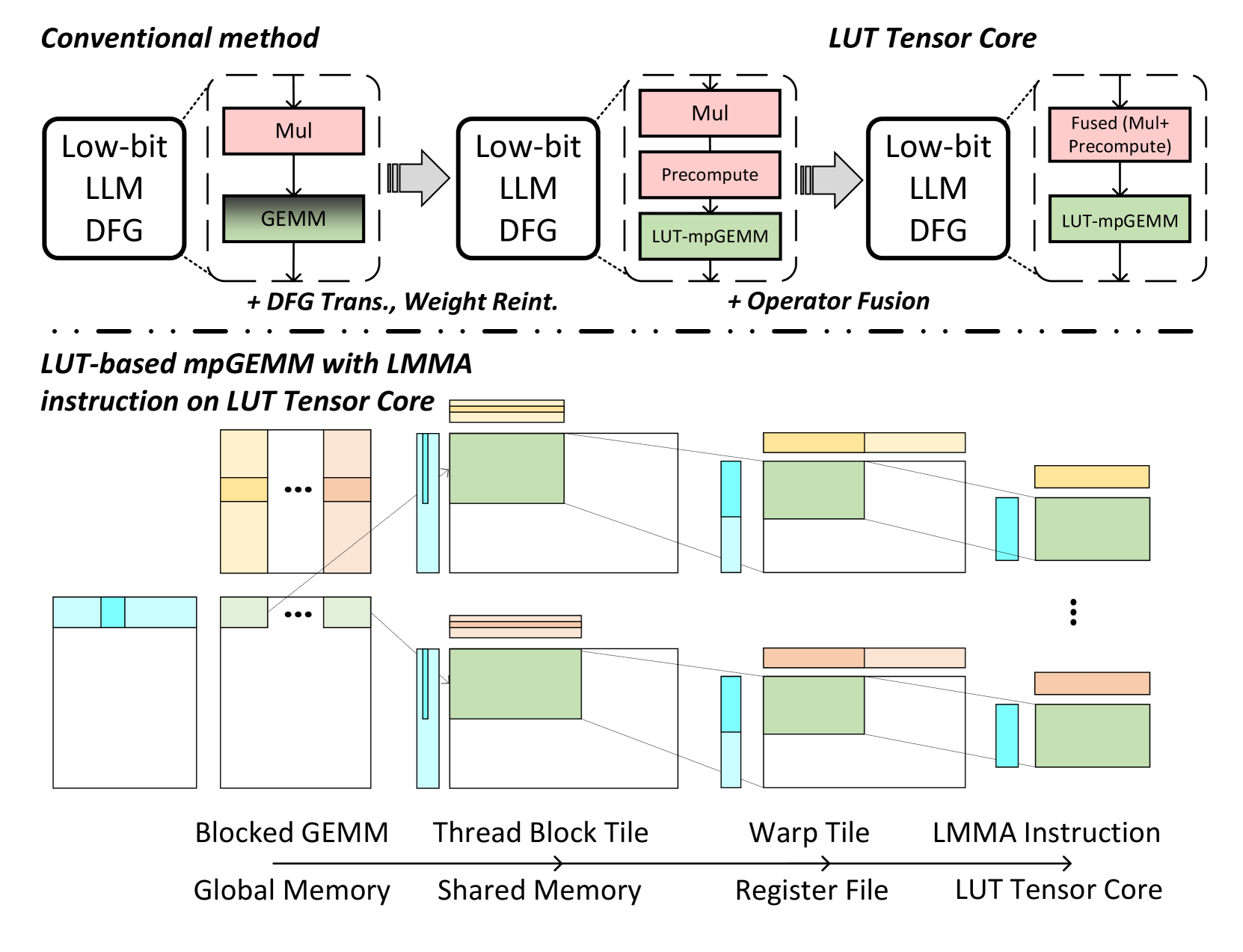
## Diagram: Comparison of Conventional Matrix Operations vs. LUT Tensor Core Optimization
### Overview
The diagram illustrates two approaches to matrix operations: a conventional method and an optimized LUT Tensor Core approach. It highlights differences in computational steps, memory usage, and instruction-level optimizations. The lower section details the LUT-based implementation with LMMA (Load Multiply Accumulate) instructions.
---
### Components/Axes
#### Conventional Method
1. **Low-bit LLM DFG** → **Mul** → **GEMM** → **Low-bit LLM DFG**
- Arrows labeled: "+ DFG Trans., Weight Reint."
2. **Low-bit LLM DFG** → **Mul** → **Precompute** → **LUT-mpGEMM** → **Low-bit LLM DFG**
- Arrows labeled: "+ Operator Fusion"
#### LUT Tensor Core
- **Fused (Mul+ Precompute)** and **LUT-mpGEMM** blocks connected to **Low-bit LLM DFG**.
#### LUT-based mpGEMM with LMMA
- **Blocked GEMM** (Global Memory) → **Thread Block Tile** (Shared Memory) → **Warp Tile** (Register File) → **LMMA Instruction** (LUT Tensor Core)
- Color-coded components:
- **Yellow**: Blocked GEMM
- **Blue**: Thread Block Tile
- **Green**: Warp Tile
- **Orange**: LMMA Instruction
---
### Detailed Analysis
#### Conventional Method
- **Flow**: Data flows through separate **Mul** and **GEMM** stages with intermediate data format conversions (DFG Trans.) and weight reintroduction.
- **Inefficiencies**: Explicit steps for data movement and operator separation increase latency.
#### LUT Tensor Core
- **Fused Operations**: Combines **Mul** and **Precompute** into a single stage, reducing intermediate steps.
- **LUT-mpGEMM**: Specialized instruction for matrix operations, optimized for low-bit precision.
#### LUT-based mpGEMM with LMMA
- **Memory Hierarchy**:
- **Global Memory** (Blocked GEMM) → **Shared Memory** (Thread Block Tile) → **Register File** (Warp Tile) → **LUT Tensor Core** (LMMA).
- **Optimization**: LMMA instructions enable in-place accumulation, minimizing register file usage and memory bandwidth.
---
### Key Observations
1. **Operator Fusion**: The LUT Tensor Core merges **Mul** and **Precompute** stages, eliminating redundant data transfers.
2. **Memory Efficiency**: The LUT-based approach reduces reliance on shared memory by leveraging the LUT Tensor Core for accumulation.
3. **Precision Handling**: Both methods use low-bit LLM DFG, but the LUT Tensor Core optimizes for low-bit precision via LMMA.
---
### Interpretation
The diagram demonstrates how the LUT Tensor Core architecture streamlines matrix operations by:
- **Fusing operations** to reduce computational overhead.
- **Optimizing memory access** through hierarchical data movement (Global → Shared → Register → LUT Core).
- **Leveraging LMMA instructions** for efficient accumulation, critical for low-bit precision workloads.
This contrasts with the conventional method, which suffers from fragmented operations and higher latency due to explicit data format conversions and weight reintroduction. The LUT-based approach is particularly advantageous for AI/ML workloads requiring frequent matrix multiplications with low-bit quantization.