## Knowledge Graph: Object Relationships
### Overview
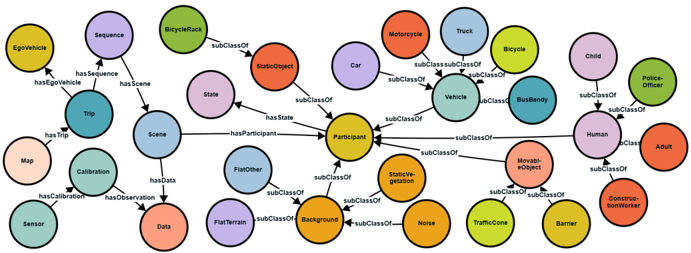
The image presents a knowledge graph illustrating relationships between various objects and concepts, primarily focusing on elements within a traffic or urban environment. The graph uses nodes (circles) to represent entities and edges (arrows) to represent relationships between them. The central node is "Participant," and other nodes are connected to it via "subClassOf" relationships. Other relationships include "hasTrip," "hasScene," "hasData," "hasEgoVehicle," "hasSequence," "hasCalibration," "hasObservation," and "hasState."
### Components/Axes
* **Nodes:** Represented as colored circles, each containing a label for an object or concept.
* **Edges:** Represented as arrows, indicating the type of relationship between nodes.
* **Central Node:** "Participant" (yellow), positioned approximately in the center of the diagram.
* **Relationships:**
* `subClassOf`: Indicates a hierarchical relationship, where one object is a specific type of another.
* `hasTrip`: Connects "Trip" to other nodes.
* `hasScene`: Connects "Scene" to other nodes.
* `hasData`: Connects "Data" to other nodes.
* `hasEgoVehicle`: Connects "EgoVehicle" to "Trip".
* `hasSequence`: Connects "Sequence" to "Trip".
* `hasCalibration`: Connects "Calibration" to "Trip".
* `hasObservation`: Connects "Data" to "Scene".
* `hasState`: Connects "State" to "Participant".
* `hasParticipant`: Connects "Scene" to "Participant".
### Detailed Analysis or Content Details
**Node Details (arranged roughly from top-left to bottom-right):**
* **EgoVehicle:** (Yellow) Located in the top-left. Connected to "Trip" via "hasEgoVehicle".
* **Sequence:** (Purple) Located to the right of "EgoVehicle". Connected to "Trip" via "hasSequence".
* **BicycleRack:** (Green) Located in the top-center. "BicycleRack" is a "subClassOf" "StaticObject".
* **StaticObject:** (Orange) Located in the upper-center. "StaticObject" is a "subClassOf" "Participant".
* **State:** (Purple) Located to the right of "StaticObject". "State" "hasState" "Participant".
* **Trip:** (Teal) Located in the center-left. Connected to "Scene".
* **Scene:** (Light Blue) Located in the center. Connected to "Trip", "Data", and "Participant".
* **Map:** (Pink) Located below "Trip".
* **Calibration:** (Teal) Located below "Trip". Connected to "Data".
* **Sensor:** (Teal) Located in the bottom-left.
* **Data:** (Orange) Located in the bottom-center. Connected to "Scene" and "Calibration".
* **FlatOther:** (Purple) Located to the left of "Participant". "FlatOther" is a "subClassOf" "Participant".
* **FlatTerrain:** (Orange) Located in the bottom-left. "FlatTerrain" is a "subClassOf" "Background".
* **Background:** (Yellow) Located in the bottom-center. "Background" is a "subClassOf" "Participant".
* **Noise:** (Orange) Located in the bottom-center. "Noise" is a "subClassOf" "Participant".
* **TrafficCone:** (Orange) Located in the bottom-right. "TrafficCone" is a "subClassOf" "MovableObject".
* **Barrier:** (Yellow) Located in the bottom-right. "Barrier" is a "subClassOf" "MovableObject".
* **Participant:** (Yellow) Located in the center.
* **Car:** (Purple) Located in the upper-center. "Car" is a "subClassOf" "Vehicle".
* **Motorcycle:** (Orange) Located in the top-right. "Motorcycle" is a "subClassOf" "Vehicle".
* **Truck:** (Light Blue) Located in the top-right. "Truck" is a "subClassOf" "Vehicle".
* **Vehicle:** (Teal) Located in the upper-right. "Vehicle" is a "subClassOf" "Participant".
* **BusBendy:** (Teal) Located to the right of "Vehicle". "BusBendy" is a "subClassOf" "Vehicle".
* **Child:** (Pink) Located in the upper-right. "Child" is a "subClassOf" "Human".
* **Police-Officer:** (Green) Located in the upper-right. "Police-Officer" is a "subClassOf" "Human".
* **Human:** (Purple) Located in the right-center. "Human" is a "subClassOf" "Participant".
* **Adult:** (Orange) Located in the right-center. "Adult" is a "subClassOf" "Human".
* **MovableObject:** (Orange) Located in the bottom-right. "MovableObject" is a "subClassOf" "Participant".
* **StaticVegetation:** (Orange) Located in the bottom-center. "StaticVegetation" is a "subClassOf" "Participant".
* **ConstructionWorker:** (Yellow) Located in the bottom-right. "ConstructionWorker" is a "subClassOf" "Human".
* **Bicycle:** (Light Blue) Located in the top-right. "Bicycle" is a "subClassOf" "Vehicle".
### Key Observations
* The central role of "Participant" indicates that the graph is structured around identifying and classifying different types of participants within a scene or system.
* The "subClassOf" relationships define a hierarchy of objects, with more general categories like "Vehicle" and "Human" branching out into more specific types like "Car," "Truck," "Child," and "Adult."
* The "has..." relationships ("hasTrip," "hasScene," etc.) describe the attributes or components associated with "Trip" and "Scene."
### Interpretation
The knowledge graph provides a structured representation of entities and their relationships within a traffic or urban environment. It highlights how different objects are categorized and how they relate to a central concept of "Participant." The graph could be used for various applications, such as:
* **Scene Understanding:** By identifying the objects present in a scene and their relationships, the graph can help in understanding the context and dynamics of the scene.
* **Autonomous Systems:** The graph can be used to inform the decision-making process of autonomous systems, such as self-driving cars, by providing a structured representation of the environment.
* **Data Analysis:** The graph can be used to analyze data collected from sensors and other sources, by providing a framework for organizing and interpreting the data.
The graph emphasizes the hierarchical nature of object classification and the importance of understanding the relationships between different entities in a complex environment. The connections between "Trip," "Scene," and "Data" suggest a focus on analyzing events and observations within a specific context.