## Line Graph: -log(1+exp(c*x)) vs x for varying c values
### Overview
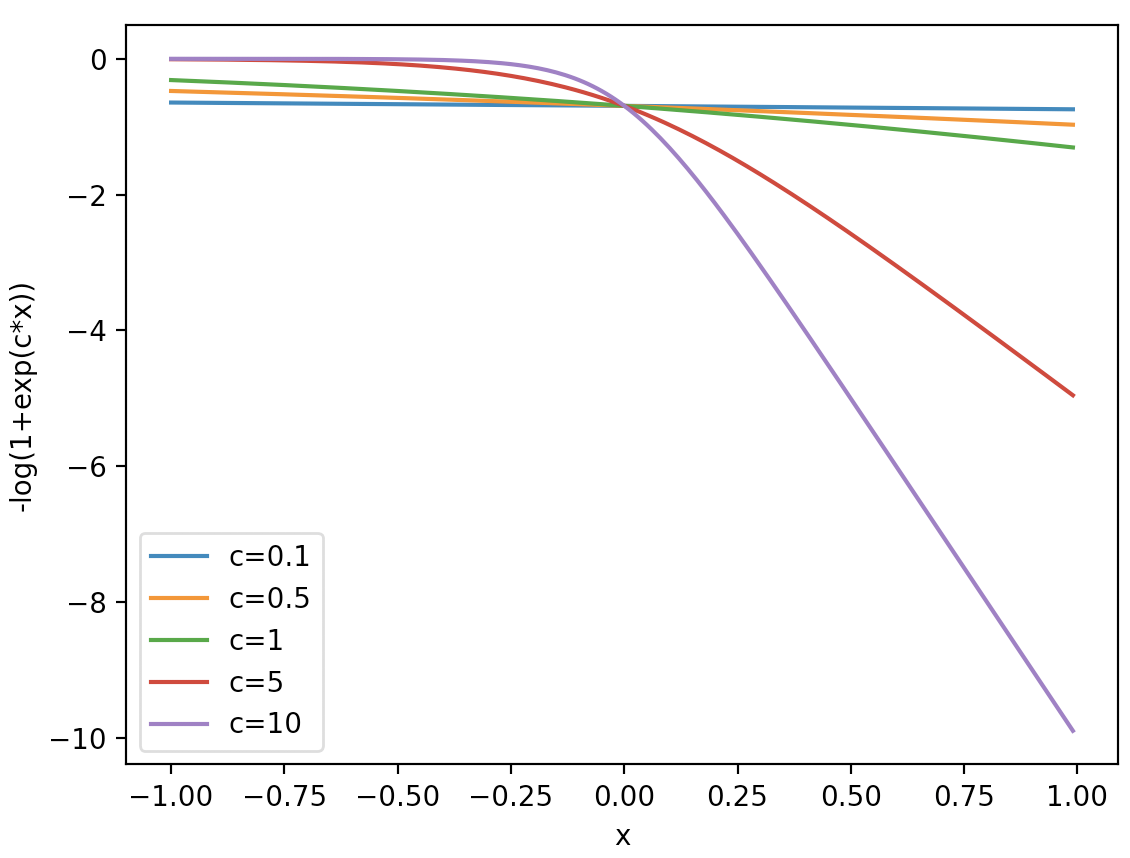
The graph displays five curves representing the function -log(1+exp(c*x)) for different constant values of c (0.1, 0.5, 1, 5, 10). The x-axis ranges from -1.00 to 1.00, while the y-axis spans from -10 to 0. All curves originate near y=0 at x=-1.00 and exhibit varying degrees of decline as x increases toward 1.00.
### Components/Axes
- **X-axis**: Labeled "x" with tick marks at -1.00, -0.75, -0.50, -0.25, 0.00, 0.25, 0.50, 0.75, 1.00.
- **Y-axis**: Labeled "-log(1+exp(c*x))" with tick marks at -10, -8, -6, -4, -2, 0.
- **Legend**: Located at the bottom-left corner, mapping colors to c values:
- Blue: c=0.1
- Orange: c=0.5
- Green: c=1
- Red: c=5
- Purple: c=10
### Detailed Analysis
1. **c=0.1 (Blue)**: Nearly flat line with minimal decline. Starts near y=0 at x=-1.00 and decreases slightly to ~y=-0.5 at x=1.00.
2. **c=0.5 (Orange)**: Slightly steeper than blue. Begins near y=0 and drops to ~y=-1.5 at x=1.00.
3. **c=1 (Green)**: Moderate decline. Starts near y=0 and reaches ~y=-3 at x=1.00.
4. **c=5 (Red)**: Sharp decline. Starts near y=0 and plunges to ~y=-7 at x=1.00.
5. **c=10 (Purple)**: Steepest slope. Begins near y=0 and falls sharply to ~y=-10 at x=1.00.
All curves intersect near x=0, where their y-values converge to approximately -0.5 to -1.0. The rate of decline increases exponentially with higher c values.
### Key Observations
- **Symmetry**: All curves are symmetric about x=0, with identical behavior for positive and negative x values.
- **Convergence**: At x=0, all curves intersect at y≈-0.5 to -1.0, regardless of c value.
- **Sensitivity**: Higher c values (5, 10) produce steeper slopes, indicating greater sensitivity to x changes.
- **Asymptotic Behavior**: Curves approach horizontal asymptotes as x→±∞ (not shown), with y-values stabilizing near -c for large |x|.
### Interpretation
The graph demonstrates how the parameter c controls the steepness of the function's response to x. Higher c values amplify the function's sensitivity, causing rapid declines for positive x and sharp rises for negative x (though only x≥-1.00 is shown). The intersection at x=0 suggests a critical point where the function's behavior transitions symmetrically. This could model phenomena like activation functions in neural networks or dose-response relationships in pharmacology, where c represents a scaling factor for input sensitivity.