## Line Graph: Effective Bandwidth vs. Offloading Ratio
### Overview
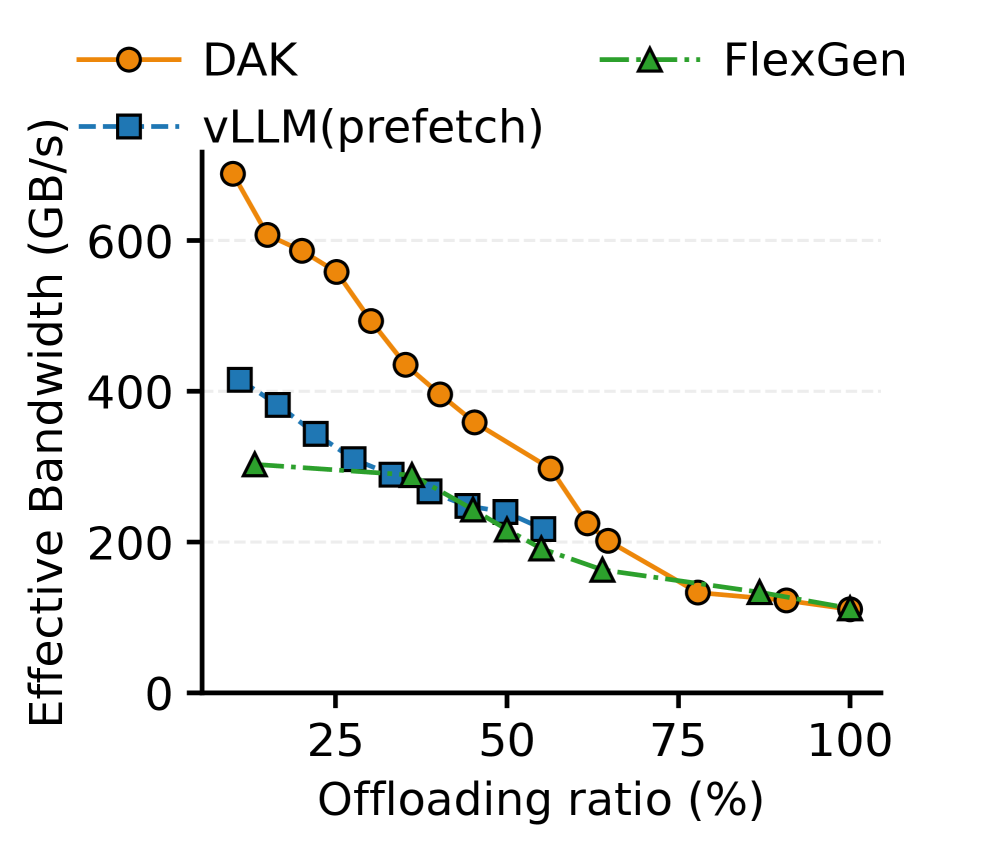
The graph compares the effective bandwidth (GB/s) of three technologies—DAK, FlexGen, and vLLM (prefetch)—across varying offloading ratios (0% to 100%). All three show a downward trend in bandwidth as offloading increases, but with distinct performance characteristics.
### Components/Axes
- **X-axis**: Offloading ratio (%) [0, 25, 50, 75, 100]
- **Y-axis**: Effective Bandwidth (GB/s) [0, 200, 400, 600]
- **Legend**:
- **DAK**: Orange circles (solid line)
- **FlexGen**: Green triangles (dashed line)
- **vLLM (prefetch)**: Blue squares (dotted line)
### Detailed Analysis
1. **DAK (Orange Circles)**:
- Starts at ~650 GB/s at 0% offloading.
- Declines steadily, reaching ~100 GB/s at 100% offloading.
- Key points:
- 25%: ~550 GB/s
- 50%: ~300 GB/s
- 75%: ~150 GB/s
2. **FlexGen (Green Triangles)**:
- Begins at ~300 GB/s at 0% offloading.
- Declines gradually, ending near ~100 GB/s at 100% offloading.
- Key points:
- 25%: ~280 GB/s
- 50%: ~200 GB/s
- 75%: ~120 GB/s
3. **vLLM (Prefetch) (Blue Squares)**:
- Starts at ~400 GB/s at 0% offloading.
- Sharp decline after 25% offloading, dropping to ~100 GB/s by 100%.
- Key points:
- 25%: ~380 GB/s
- 50%: ~220 GB/s
- 75%: ~110 GB/s
### Key Observations
- **DAK** maintains the highest bandwidth across all offloading ratios, suggesting superior scalability.
- **vLLM (prefetch)** experiences the steepest drop, particularly between 25% and 50% offloading, indicating potential inefficiencies in prefetching at higher ratios.
- **FlexGen** exhibits a moderate decline, balancing performance and scalability.
### Interpretation
The data suggests that **DAK** is the most robust technology for maintaining effective bandwidth as offloading increases, likely due to optimized resource allocation or architecture. **vLLM (prefetch)**’s sharp decline implies that prefetching mechanisms may become a bottleneck at higher offloading ratios, possibly due to overhead or contention. **FlexGen** offers a middle-ground solution, with a slower degradation rate than vLLM but lower baseline performance than DAK.
The trends highlight trade-offs between offloading efficiency and bandwidth retention, with DAK emerging as the most scalable option for high offloading scenarios.