## Diagram: Goals, Challenges, Methodology, Architecture, Deployment
### Overview
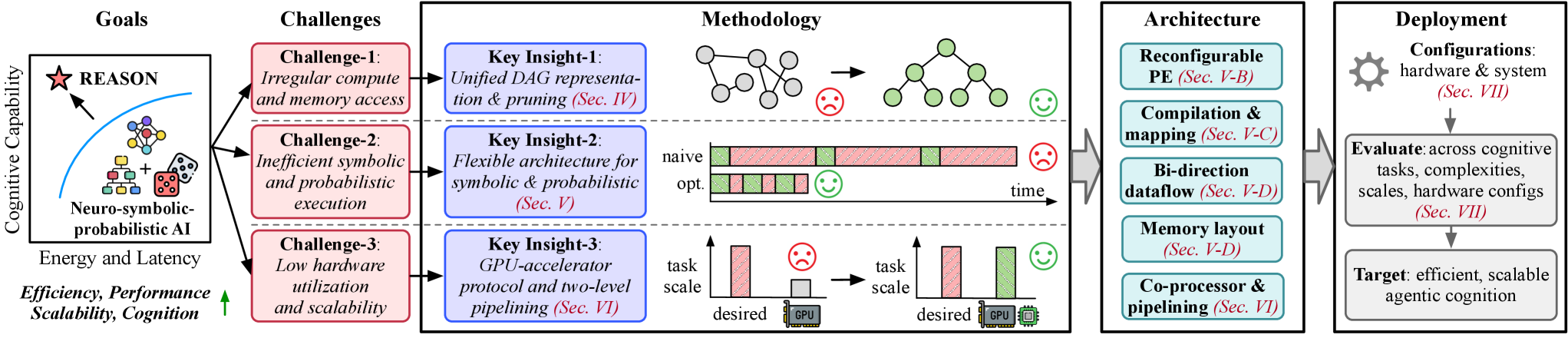
The image presents a diagram outlining the goals, challenges, methodology, architecture, and deployment aspects of a system, likely related to cognitive computing or AI. It illustrates the progression from high-level objectives to specific implementation details.
### Components/Axes
**Goals:**
* **Y-axis:** Cognitive Capability
* **X-axis:** Energy and Latency
* **Curve:** A blue curve indicates the desired relationship between cognitive capability and energy/latency.
* **Point:** A red star labeled "REASON" is positioned at the top-left of the graph, indicating a target state.
* **Text:** "Neuro-symbolic-probabilistic AI" is positioned in the center of the graph.
* **Text:** "Efficiency, Performance, Scalability, Cognition" with a green upward arrow.
**Challenges:**
* **Challenge-1:** Irregular compute and memory access
* **Challenge-2:** Inefficient symbolic and probabilistic execution
* **Challenge-3:** Low hardware utilization and scalability
**Methodology:**
* **Key Insight-1:** Unified DAG representation & pruning (Sec. IV)
* Diagram: A graph of interconnected nodes transforms into a tree structure. A red sad face is below the initial graph, and a green happy face is below the tree structure.
* **Key Insight-2:** Flexible architecture for symbolic & probabilistic (Sec. V)
* Diagram: A timeline labeled "naive" shows alternating red (cross-hatched) and green blocks. A timeline labeled "opt." shows a higher proportion of green blocks. A red sad face is to the right of the "naive" timeline, and a green happy face is to the right of the "opt." timeline.
* **Key Insight-3:** GPU-accelerator protocol and two-level pipelining (Sec. VI)
* Diagram: Two bar graphs labeled "task scale". The first shows a red (cross-hatched) bar for "desired" and a smaller gray bar for "GPU". The second shows a green bar for "desired" and a green bar for "GPU" and a green happy face.
**Architecture:**
* Reconfigurable PE (Sec. V-B)
* Compilation & mapping (Sec. V-C)
* Bi-direction dataflow (Sec. V-D)
* Memory layout (Sec. V-D)
* Co-processor & pipelining (Sec. VI)
**Deployment:**
* Configurations: hardware & system (Sec. VII)
* Evaluate: across cognitive tasks, complexities, scales, hardware configs (Sec. VII)
* Target: efficient, scalable agentic cognition
### Detailed Analysis
* **Goals:** The graph illustrates the trade-off between cognitive capability and energy/latency. The "REASON" point represents an ideal state of high cognitive capability with low energy/latency.
* **Challenges:** The challenges highlight key bottlenecks in achieving the desired goals, including irregular memory access, inefficient execution, and low hardware utilization.
* **Methodology:** The methodology section outlines key insights and approaches to address the identified challenges. These include unified DAG representation, flexible architecture, and GPU-accelerator protocols. The diagrams show the progression from a less optimal state (red sad face) to a more optimal state (green happy face).
* **Architecture:** The architecture section lists key components of the system, including reconfigurable processing elements, compilation and mapping strategies, bi-directional dataflow, memory layout, and co-processor pipelining.
* **Deployment:** The deployment section outlines the steps involved in deploying the system, including configuration, evaluation, and targeting efficient and scalable agentic cognition.
### Key Observations
* The diagram presents a clear and concise overview of the system's goals, challenges, methodology, architecture, and deployment.
* The use of diagrams and visual cues (e.g., happy/sad faces, upward arrow) effectively communicates the key concepts.
* The references to specific sections (e.g., Sec. IV, Sec. V-B) provide pointers to more detailed information.
### Interpretation
The diagram illustrates a systematic approach to developing a cognitive computing system. It starts with clearly defined goals, identifies key challenges, proposes innovative methodologies, outlines the system architecture, and describes the deployment process. The emphasis on efficiency, performance, scalability, and cognition suggests a focus on building a high-performance system that can effectively address complex cognitive tasks. The progression from challenges to key insights and methodologies demonstrates a problem-solving approach. The architecture and deployment sections provide a roadmap for implementing and deploying the system. The overall diagram suggests a well-thought-out and comprehensive approach to cognitive computing system development.