## Line Chart: CIFAR-100 Test Accuracy vs. d₁
### Overview
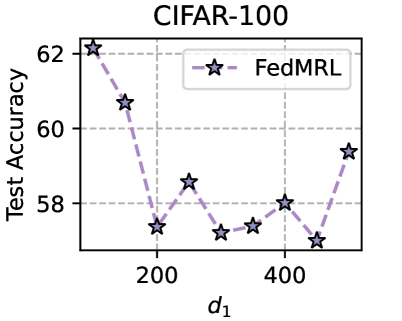
The image is a line chart titled "CIFAR-100," plotting "Test Accuracy" against a parameter labeled "d₁." It displays a single data series for a method or model named "FedMRL." The chart shows how the test accuracy on the CIFAR-100 dataset changes as the value of d₁ increases.
### Components/Axes
* **Chart Title:** "CIFAR-100" (centered at the top).
* **Y-Axis:**
* **Label:** "Test Accuracy" (rotated vertically on the left).
* **Scale:** Linear scale with major tick marks and grid lines at 58, 60, and 62.
* **X-Axis:**
* **Label:** "d₁" (centered at the bottom).
* **Scale:** Linear scale with major tick marks and grid lines at 200 and 400. The axis appears to start at approximately 100 and end at approximately 500.
* **Legend:**
* **Placement:** Top-right corner, inside the plot area.
* **Content:** A purple dashed line with a star marker, labeled "FedMRL."
* **Data Series:**
* **Label:** "FedMRL" (from legend).
* **Visual Style:** A purple dashed line connecting star-shaped markers (☆).
### Detailed Analysis
The data series "FedMRL" is plotted as a series of discrete points connected by a dashed line. The approximate values, read from the chart, are as follows. (Note: Values are estimated based on visual alignment with the grid lines; inherent uncertainty exists.)
| Approximate d₁ Value | Approximate Test Accuracy | Visual Trend Description |
| :--- | :--- | :--- |
| ~100 | ~62.1 | Starting point, highest accuracy on the chart. |
| ~150 | ~60.7 | Sharp downward slope from the first point. |
| ~200 | ~57.5 | Continues steep decline, reaching a local minimum. |
| ~250 | ~58.6 | Slopes upward from the previous point. |
| ~300 | ~57.3 | Slopes downward again. |
| ~350 | ~57.5 | Slight upward slope. |
| ~400 | ~58.0 | Continues slight upward slope. |
| ~450 | ~57.0 | Slopes downward to the lowest point on the chart. |
| ~500 | ~59.4 | Sharp upward slope to the final point. |
**Trend Verification:** The overall visual trend is a steep initial decline from d₁≈100 to d₁≈200, followed by a period of fluctuation between approximately 57% and 59.5% accuracy for d₁ values between 200 and 500. The line does not show a consistent monotonic increase or decrease after the initial drop.
### Key Observations
1. **Initial Sensitivity:** The FedMRL model's test accuracy is highly sensitive to the parameter d₁ in the lower range (100 to 200), showing a significant drop of approximately 4.6 percentage points.
2. **Performance Plateau/Fluctuation:** For d₁ values greater than 200, the accuracy stabilizes within a relatively narrow band (57.0% to 59.4%), suggesting a region of reduced sensitivity or a performance plateau with minor fluctuations.
3. **Non-Monotonic Behavior:** The relationship is non-monotonic. After the initial drop, accuracy does not consistently improve or degrade with increasing d₁ but oscillates.
4. **Extremes:** The highest observed accuracy (~62.1%) occurs at the smallest d₁ value (~100). The lowest observed accuracy (~57.0%) occurs at d₁≈450.
### Interpretation
This chart demonstrates the impact of the hyperparameter `d₁` on the generalization performance (test accuracy) of the "FedMRL" method on the CIFAR-100 benchmark. The data suggests a critical trade-off or an optimal operating point.
* **Underlying Relationship:** The steep initial decline implies that very small values of `d₁` (around 100) are highly beneficial for this model's accuracy. Increasing `d₁` beyond this point initially harms performance significantly.
* **Stability Region:** The subsequent fluctuation indicates that for a wide range of larger `d₁` values (200-500), the model's performance is relatively stable but suboptimal compared to the low-`d₁` regime. The fluctuations may be due to stochasticity in training or a complex, non-linear interaction between `d₁` and other factors.
* **Practical Implication:** For practitioners using FedMRL on CIFAR-100, this chart argues for selecting a small `d₁` value (near 100) to maximize accuracy. The parameter should be tuned carefully in this lower range, as performance degrades rapidly with increase. The lack of a clear upward trend at higher values suggests that simply increasing `d₁` is not a viable strategy for improving accuracy beyond the initial peak.
* **Investigative Question:** The chart raises the question of what `d₁` represents (e.g., a dimension, a distance threshold, a regularization parameter). Its strong negative correlation with accuracy in the initial phase is the key finding, warranting further investigation into the mechanism by which `d₁` influences the FedMRL learning process.