## Bar Chart: Performance of Different Methods Across Knowledge Graph Levels
### Overview
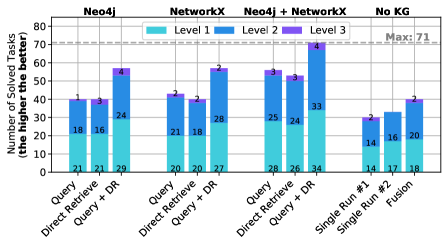
The chart compares the number of solved tasks across different methods (Neo4j, NetworkX, Neo4j + NetworkX, No KG) and knowledge graph (KG) levels (Level 1, Level 2, Level 3). The y-axis represents the number of solved tasks, with higher values indicating better performance. The x-axis categorizes methods and their configurations, including "Query," "Direct Retrieve," "Query + DR," "Single Run #1," "Single Run #2," and "Fusion." The legend distinguishes the three KG levels by color: cyan (Level 1), blue (Level 2), and purple (Level 3). The maximum value on the y-axis is 71, marked by a dashed line.
### Components/Axes
- **X-axis**: Categories of methods and configurations:
- Neo4j
- NetworkX
- Neo4j + NetworkX
- No KG
- Subcategories: Query, Direct Retrieve, Query + DR, Single Run #1, Single Run #2, Fusion
- **Y-axis**: Number of solved tasks (0–80), with a dashed line at 71.
- **Legend**:
- Level 1 (cyan)
- Level 2 (blue)
- Level 3 (purple)
- **Axis Titles**:
- Y-axis: "Number of Solved Tasks (the higher the better)"
- X-axis: Method/Configuration labels
### Detailed Analysis
- **Neo4j**:
- Query: Level 1 (18), Level 2 (16), Level 3 (24)
- Direct Retrieve: Level 1 (21), Level 2 (18), Level 3 (29)
- Query + DR: Level 1 (21), Level 2 (18), Level 3 (29)
- **NetworkX**:
- Query: Level 1 (21), Level 2 (18), Level 3 (27)
- Direct Retrieve: Level 1 (20), Level 2 (20), Level 3 (27)
- Query + DR: Level 1 (28), Level 2 (26), Level 3 (34)
- **Neo4j + NetworkX**:
- Query: Level 1 (28), Level 2 (26), Level 3 (34)
- Direct Retrieve: Level 1 (25), Level 2 (24), Level 3 (33)
- Query + DR: Level 1 (28), Level 2 (26), Level 3 (34)
- **No KG**:
- Single Run #1: Level 1 (14), Level 2 (16), Level 3 (18)
- Single Run #2: Level 1 (17), Level 2 (20), Level 3 (20)
- Fusion: Level 1 (18), Level 2 (20), Level 3 (20)
### Key Observations
1. **Highest Performance**:
- "Query + DR" under "Neo4j + NetworkX" achieves the highest number of solved tasks (34 at Level 3).
- "Direct Retrieve" under "Neo4j" also performs well (29 at Level 3).
2. **Lowest Performance**:
- "Single Run #1" under "No KG" has the lowest values (14 at Level 1, 16 at Level 2, 18 at Level 3).
3. **Trends**:
- "Query + DR" consistently outperforms other configurations across all methods.
- "No KG" methods show significantly lower performance compared to others.
- Level 3 (purple) bars are generally taller than Level 1 and 2, indicating better performance at higher KG levels.
### Interpretation
The data suggests that combining Neo4j and NetworkX (Neo4j + NetworkX) yields the best results, particularly in the "Query + DR" configuration. This implies that integrating multiple knowledge graph systems enhances task-solving capabilities. The "No KG" setup underperforms, highlighting the importance of KG integration. The consistent improvement from Level 1 to Level 3 across methods indicates that higher KG levels correlate with better performance. The "Fusion" method under "No KG" shows moderate improvement but still lags behind KG-integrated approaches. This chart underscores the value of hybrid systems and structured KG levels in optimizing task-solving efficiency.