## Patient Heart Disease Probability Report
### Overview
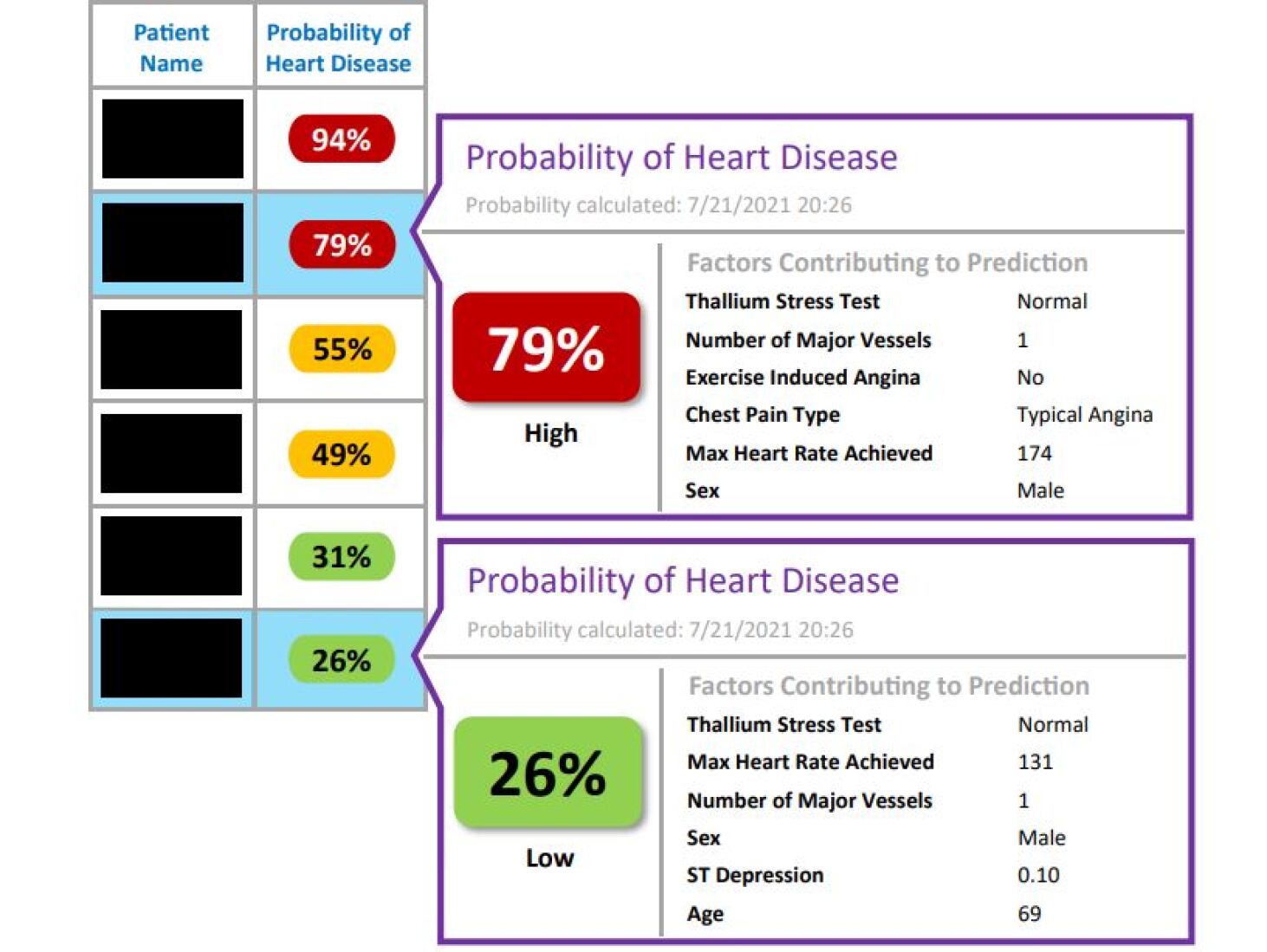
The image presents a patient heart disease probability report, displaying the calculated probability of heart disease for multiple patients along with factors contributing to the prediction for two specific patients. The report includes patient names (blacked out for privacy), their corresponding heart disease probability percentages, and associated risk levels (High, Low).
### Components/Axes
* **Columns:** The report is structured with two primary columns: "Patient Name" and "Probability of Heart Disease".
* **Probability of Heart Disease:** This column displays the calculated probability as a percentage, with associated color-coding and risk level labels.
* **Risk Levels:** The risk levels are categorized as "High" and "Low".
* **Factors Contributing to Prediction:** This section lists specific factors used in the probability calculation, such as Thallium Stress Test results, Number of Major Vessels, Exercise Induced Angina, Chest Pain Type, Max Heart Rate Achieved, Sex, ST Depression, and Age.
* **Calculation Date:** The probability calculation date is 7/21/2021 20:26.
### Detailed Analysis or ### Content Details
**Patient Data:**
* **Patient 1:** Probability of Heart Disease: 94% (Color: Red)
* **Patient 2:** Probability of Heart Disease: 79% (Color: Red)
* **Patient 3:** Probability of Heart Disease: 55% (Color: Yellow)
* **Patient 4:** Probability of Heart Disease: 49% (Color: Yellow)
* **Patient 5:** Probability of Heart Disease: 31% (Color: Green)
* **Patient 6:** Probability of Heart Disease: 26% (Color: Green)
**Detailed Patient Information (Patient with 79% probability):**
* Probability of Heart Disease: 79% (Color: Red)
* Risk Level: High
* Factors Contributing to Prediction:
* Thallium Stress Test: Normal
* Number of Major Vessels: 1
* Exercise Induced Angina: No
* Chest Pain Type: Typical Angina
* Max Heart Rate Achieved: 174
* Sex: Male
**Detailed Patient Information (Patient with 26% probability):**
* Probability of Heart Disease: 26% (Color: Green)
* Risk Level: Low
* Factors Contributing to Prediction:
* Thallium Stress Test: Normal
* Max Heart Rate Achieved: 131
* Number of Major Vessels: 1
* Sex: Male
* ST Depression: 0.10
* Age: 69
### Key Observations
* The probability of heart disease varies significantly among the patients, ranging from 26% to 94%.
* Higher probability percentages are associated with a "High" risk level, while lower percentages are associated with a "Low" risk level.
* The factors contributing to the prediction differ between the two detailed patient examples, highlighting the individualized nature of the risk assessment.
* The patient with a 79% probability has a higher Max Heart Rate Achieved (174) compared to the patient with a 26% probability (131).
* The patient with a 26% probability has an ST Depression value of 0.10 and an age of 69, factors not listed for the patient with 79% probability.
### Interpretation
The report suggests a personalized approach to assessing heart disease risk, where individual factors are considered to calculate the probability of heart disease. The color-coding and risk level labels provide a quick visual assessment of each patient's risk. The detailed patient information sections offer insights into the specific factors that contribute to the calculated probability, allowing for a more comprehensive understanding of the risk assessment. The differences in contributing factors between the two detailed patients highlight the importance of considering individual patient characteristics when evaluating heart disease risk.