\n
## Bar Charts: Accuracy and Error Metrics for Reflective Execution
### Overview
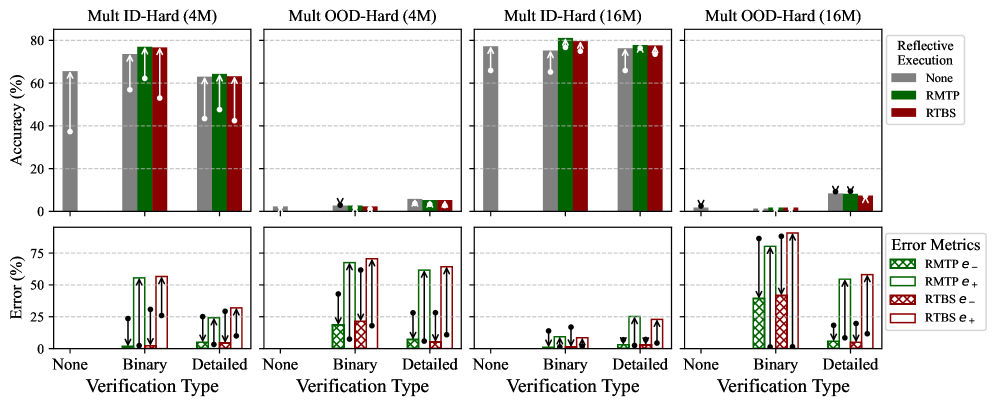
The image presents a set of four bar charts arranged horizontally, each representing a different experimental condition. The top row displays accuracy metrics, while the bottom row displays error metrics. The charts compare the performance of different verification types (None, Binary, Detailed) under various reflective execution scenarios (None, RMTP, RTBS). The conditions are "Mult ID-Hard (4M)", "Mult OOD-Hard (4M)", "Mult ID-Hard (16M)", and "Mult OOD-Hard (16M)".
### Components/Axes
* **X-axis (all charts):** Verification Type - with categories: None, Binary, Detailed.
* **Y-axis (top row):** Accuracy (%) - Scale ranges from 0 to 80.
* **Y-axis (bottom row):** Error (%) - Scale ranges from 0 to 75.
* **Legend (top row):** Reflective Execution - with categories: None (light green), RMTP (dark green), RTBS (red).
* **Legend (bottom row):** Error Metrics - with categories: RMTP e- (green diagonal stripes), RMTP e+ (green crosses), RTBS e- (red diagonal stripes), RTBS e+ (red crosses).
* **Chart Titles:** "Mult ID-Hard (4M)", "Mult OOD-Hard (4M)", "Mult ID-Hard (16M)", "Mult OOD-Hard (16M)".
* **Arrows:** Upward arrows indicate statistically significant increases in accuracy. Downward arrows indicate statistically significant decreases in accuracy.
### Detailed Analysis or Content Details
**Chart 1: Mult ID-Hard (4M)**
* **Accuracy:**
* None: Approximately 62% for all reflective execution types.
* Binary: Approximately 65% for None, 68% for RMTP, and 63% for RTBS. An upward arrow is present between None and RMTP.
* Detailed: Approximately 65% for None, 68% for RMTP, and 63% for RTBS. An upward arrow is present between None and RMTP.
* **Error:**
* None: Low error (around 5-10%) for all error metrics.
* Binary: RMTP e- is around 20%, RMTP e+ is around 10%, RTBS e- is around 25%, RTBS e+ is around 15%.
* Detailed: RMTP e- is around 30%, RMTP e+ is around 10%, RTBS e- is around 35%, RTBS e+ is around 15%.
**Chart 2: Mult OOD-Hard (4M)**
* **Accuracy:**
* None: Approximately 60% for all reflective execution types.
* Binary: Approximately 65% for None, 68% for RMTP, and 63% for RTBS. An upward arrow is present between None and RMTP.
* Detailed: Approximately 65% for None, 68% for RMTP, and 63% for RTBS. An upward arrow is present between None and RMTP.
* **Error:**
* None: Low error (around 5-10%) for all error metrics.
* Binary: RMTP e- is around 20%, RMTP e+ is around 10%, RTBS e- is around 25%, RTBS e+ is around 15%.
* Detailed: RMTP e- is around 30%, RMTP e+ is around 10%, RTBS e- is around 35%, RTBS e+ is around 15%.
**Chart 3: Mult ID-Hard (16M)**
* **Accuracy:**
* None: Approximately 75% for all reflective execution types.
* Binary: Approximately 78% for None, 80% for RMTP, and 76% for RTBS. An upward arrow is present between None and RMTP.
* Detailed: Approximately 78% for None, 80% for RMTP, and 76% for RTBS. An upward arrow is present between None and RMTP.
* **Error:**
* None: Low error (around 5-10%) for all error metrics.
* Binary: RMTP e- is around 15%, RMTP e+ is around 5%, RTBS e- is around 20%, RTBS e+ is around 10%.
* Detailed: RMTP e- is around 25%, RMTP e+ is around 5%, RTBS e- is around 30%, RTBS e+ is around 10%.
**Chart 4: Mult OOD-Hard (16M)**
* **Accuracy:**
* None: Approximately 75% for all reflective execution types.
* Binary: Approximately 78% for None, 80% for RMTP, and 76% for RTBS. An upward arrow is present between None and RMTP.
* Detailed: Approximately 78% for None, 80% for RMTP, and 76% for RTBS. An upward arrow is present between None and RMTP.
* **Error:**
* None: Low error (around 5-10%) for all error metrics.
* Binary: RMTP e- is around 15%, RMTP e+ is around 5%, RTBS e- is around 20%, RTBS e+ is around 10%.
* Detailed: RMTP e- is around 25%, RMTP e+ is around 5%, RTBS e- is around 30%, RTBS e+ is around 10%.
### Key Observations
* RMTP consistently improves accuracy compared to None across all conditions.
* RTBS generally performs similarly to None in terms of accuracy.
* Error metrics show that RMTP e- and RTBS e- are the highest contributors to error, especially with Detailed verification.
* Increasing the model size from 4M to 16M generally improves accuracy.
* The effect of RMTP is more pronounced with larger model sizes (16M).
### Interpretation
The data suggests that reflective execution with RMTP significantly improves accuracy, particularly for larger models and more challenging conditions (OOD-Hard). The increased accuracy comes at the cost of higher error rates for RMTP e- and RTBS e-, indicating that these error types are more frequent when using reflective execution. The consistent performance of RTBS suggests it doesn't offer a substantial benefit over no reflective execution. The upward arrows consistently pointing from "None" to "RMTP" across all charts strongly indicate a statistically significant positive impact of RMTP on accuracy. The error metrics provide a more nuanced understanding of the trade-offs involved in using reflective execution, highlighting the need to address the specific error types that are exacerbated by these techniques. The fact that the benefits of RMTP are more pronounced with larger models suggests that reflective execution may be particularly valuable for scaling up model size.