\n
## Diagram: Knowledge Hierarchy for ReLU Training
### Overview
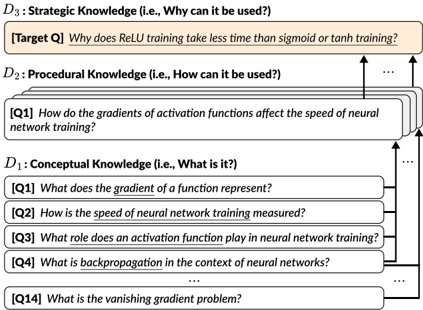
The image presents a diagram illustrating a hierarchical breakdown of knowledge required to understand why ReLU (Rectified Linear Unit) training takes less time than sigmoid or tanh training. The hierarchy is structured into three levels: Strategic Knowledge (D3), Procedural Knowledge (D2), and Conceptual Knowledge (D1), each containing related questions. Arrows indicate dependencies between the levels.
### Components/Axes
The diagram is divided into three horizontal sections, labeled D1, D2, and D3. Each section represents a different level of knowledge. Within each section, there are multiple questions (Q1, Q2, etc.) listed in rectangular boxes. Arrows point upwards from questions in lower levels to questions in higher levels, indicating that answering questions in lower levels contributes to answering questions in higher levels. The top section contains a "Target Q" box.
### Detailed Analysis or Content Details
* **D3: Strategic Knowledge (i.e., Why can it be used?)**
* Contains the "Target Q": "Why does ReLU training take less time than sigmoid or tanh training?"
* **D2: Procedural Knowledge (i.e., How can it be used?)**
* Contains the question: "Q1 How do the gradients of activation functions affect the speed of neural network training?"
* An ellipsis (...) indicates that there are more questions in this level, but they are not fully displayed.
* **D1: Conceptual Knowledge (i.e., What is it?)**
* Contains the following questions:
* "Q1 What does the gradient of a function represent?"
* "Q2 How is the speed of neural network training measured?"
* "Q3 What role does an activation function play in neural network training?"
* "Q4 What is backpropagation in the context of neural networks?"
* An ellipsis (...) indicates that there are more questions in this level, but they are not fully displayed.
* "Q14 What is the vanishing gradient problem?"
Arrows connect questions across levels:
* An arrow points from "Q1" in D1 to "Q1" in D2.
* An arrow points from D2 to the "Target Q" in D3.
* An arrow points from D1 to D2.
### Key Observations
The diagram illustrates a dependency structure where understanding fundamental concepts (D1) is necessary to understand how to apply them (D2), which in turn is necessary to answer the overarching strategic question (D3). The ellipsis suggests that each level contains a more extensive set of questions than what is shown. The diagram is a visual representation of a knowledge decomposition.
### Interpretation
This diagram represents a pedagogical approach to understanding a complex topic – the efficiency of ReLU training. It breaks down the problem into manageable components, starting with foundational concepts (gradients, activation functions, backpropagation) and building towards a procedural understanding (how gradients affect training speed) and finally, a strategic understanding (why ReLU is faster). The diagram suggests that a complete understanding of the target question requires mastery of all three levels of knowledge. The use of "Target Q" emphasizes the ultimate goal of the learning process. The diagram is not presenting data, but rather a framework for organizing knowledge. It's a conceptual map, not a quantitative chart. The diagram implies that the vanishing gradient problem (Q14) is a key conceptual element in understanding why ReLU training is faster, as it is a common issue with sigmoid and tanh activation functions.