## Heatmap: Addition Accuracy by Number of Operands
### Overview
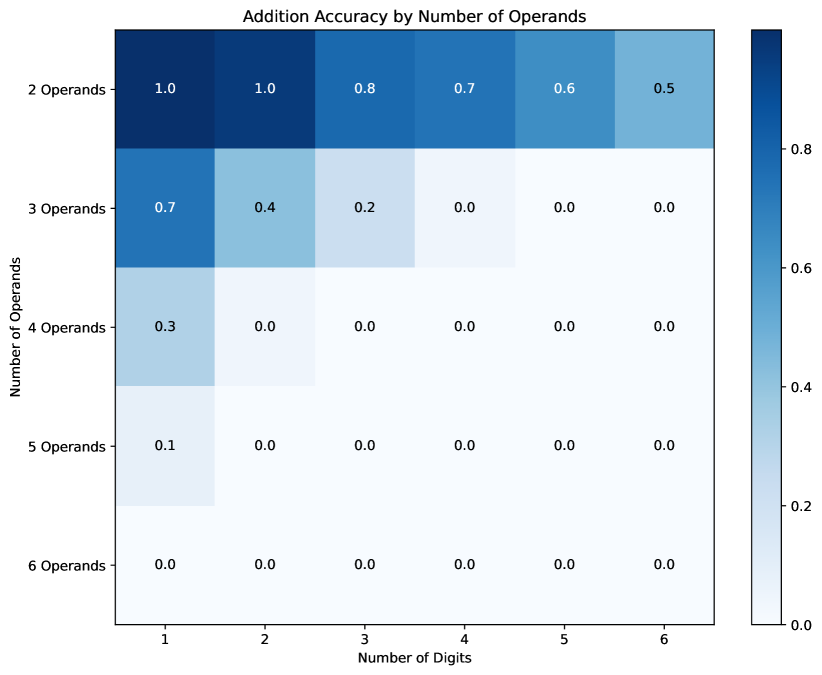
The image is a heatmap titled "Addition Accuracy by Number of Operands." It visualizes the accuracy (ranging from 0.0 to 1.0) of a system performing addition problems, categorized by the number of operands (rows) and the number of digits per operand (columns). The color intensity, from dark blue (high accuracy) to white (zero accuracy), corresponds to the numerical accuracy score displayed in each cell.
### Components/Axes
* **Title:** "Addition Accuracy by Number of Operands" (centered at the top).
* **Y-Axis (Vertical):** Labeled "Number of Operands." It contains five categorical rows: "2 Operands", "3 Operands", "4 Operands", "5 Operands", and "6 Operands".
* **X-Axis (Horizontal):** Labeled "Number of Digits." It contains six categorical columns labeled with the integers 1, 2, 3, 4, 5, and 6.
* **Color Bar/Legend:** Positioned vertically on the right side of the chart. It maps color to accuracy values, with a scale from 0.0 (white) to approximately 1.0 (dark blue). Major tick marks are at 0.0, 0.2, 0.4, 0.6, and 0.8.
* **Data Cells:** A 5x6 grid where each cell contains a numerical accuracy value and is colored according to the legend.
### Detailed Analysis
The following table reconstructs the data from the heatmap. Values are read directly from the cells.
| Number of Operands | 1 Digit | 2 Digits | 3 Digits | 4 Digits | 5 Digits | 6 Digits |
| :--- | :--- | :--- | :--- | :--- | :--- | :--- |
| **2 Operands** | 1.0 | 1.0 | 0.8 | 0.7 | 0.6 | 0.5 |
| **3 Operands** | 0.7 | 0.4 | 0.2 | 0.0 | 0.0 | 0.0 |
| **4 Operands** | 0.3 | 0.0 | 0.0 | 0.0 | 0.0 | 0.0 |
| **5 Operands** | 0.1 | 0.0 | 0.0 | 0.0 | 0.0 | 0.0 |
| **6 Operands** | 0.0 | 0.0 | 0.0 | 0.0 | 0.0 | 0.0 |
**Trend Verification:**
* **Row Trend (Fixed Operands, Increasing Digits):** For any given number of operands, accuracy **decreases** as the number of digits increases. The slope is steepest for 2 and 3 operands.
* **Column Trend (Fixed Digits, Increasing Operands):** For any given number of digits, accuracy **decreases** as the number of operands increases. The drop is precipitous after 2 operands.
### Key Observations
1. **Perfect Performance Zone:** The system achieves perfect accuracy (1.0) only for the simplest problems: adding 2 operands that are 1 or 2 digits long.
2. **Sharp Performance Cliff:** There is a dramatic drop in accuracy when moving from 2 to 3 operands. For example, with 1-digit numbers, accuracy falls from 1.0 to 0.7.
3. **Complete Failure Threshold:** For problems involving 6 operands, accuracy is 0.0 across all digit lengths. For 5 operands, accuracy is only non-zero (0.1) for 1-digit numbers.
4. **Digit Length Impact:** The negative impact of adding more digits is most pronounced for 2 and 3 operands. For 4 or more operands, accuracy is already at or near zero for most digit lengths, so adding digits has little visible effect.
5. **Asymmetry of Difficulty:** Adding a third operand appears to be a significantly harder task for the system than increasing the digit length of a 2-operand problem. For instance, 2 operands with 6 digits (accuracy 0.5) is handled better than 3 operands with 1 digit (accuracy 0.7) or 2 digits (accuracy 0.4).
### Interpretation
This heatmap demonstrates a clear and severe limitation in the evaluated system's arithmetic reasoning capabilities. The data suggests the system's "working memory" or procedural logic for addition is highly constrained.
* **Core Limitation:** The primary bottleneck is the **number of operands**, not the digit length. The system can handle multi-digit numbers reasonably well if only adding two of them, but its performance collapses when required to sum three or more numbers. This indicates a potential failure in managing intermediate sums or in the sequential execution of multiple addition operations.
* **Cognitive Load Analogy:** The pattern mirrors a cognitive load theory model. The task's difficulty increases multiplicatively with both operands and digits, but the system hits a hard capacity limit at around 3 operands, beyond which it fails almost completely.
* **Practical Implication:** The system is reliable only for very basic arithmetic (2-operand addition of small numbers). It is not suitable for more complex calculations, such as summing a list of numbers or handling financial calculations with multiple line items. The perfect 1.0 scores for the simplest cases confirm the system understands the basic operation, but the rapid degradation reveals it lacks the robustness needed for general-purpose arithmetic.