## Diagram: LLM Drafting Methods
### Overview
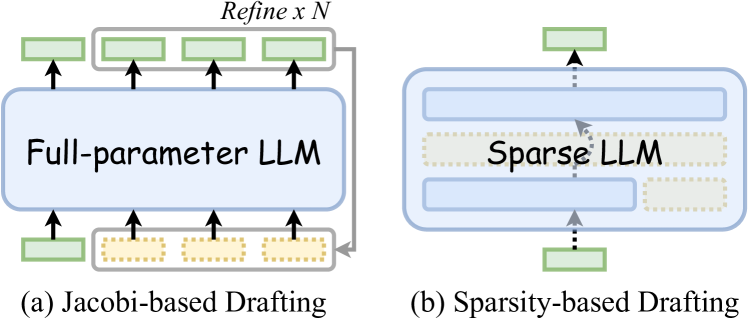
The image presents two diagrams illustrating different drafting methods for Large Language Models (LLMs): Jacobi-based Drafting and Sparsity-based Drafting. Each diagram shows the flow of information and the interaction between different components.
### Components/Axes
**Diagram (a): Jacobi-based Drafting**
* **Main Component:** A rounded rectangle labeled "Full-parameter LLM" in the center. The rectangle has a light blue fill and a darker blue outline.
* **Input Blocks:** Three blocks at the bottom, each with a dotted yellow fill and a gray outline.
* **Output Blocks:** Three blocks at the top, each with a solid green fill and a gray outline.
* **Refinement Loop:** A gray rounded rectangle encompassing the top output blocks, labeled "Refine x N" at the top.
* **Arrows:** Black arrows indicate the flow of information. Arrows point upwards from the input blocks to the "Full-parameter LLM," and from the "Full-parameter LLM" to the output blocks. A gray arrow connects the rightmost output block back to the bottom input blocks.
* **Title:** "(a) Jacobi-based Drafting" is located below the diagram.
**Diagram (b): Sparsity-based Drafting**
* **Main Component:** A rounded rectangle containing three horizontal layers. The top and bottom layers have a solid light blue fill and a darker blue outline. The middle layer has a dotted yellow fill and a gray outline. The text "Sparse LLM" is written in the middle layer.
* **Input Block:** A block at the bottom with a solid green fill.
* **Output Block:** A block at the top with a solid green fill.
* **Arrows:** Dashed black arrows indicate the flow of information. An arrow points upwards from the input block to the bottom layer of the "Sparse LLM." An arrow points upwards from the middle layer to the top layer. An arrow points upwards from the top layer to the output block.
* **Title:** "(b) Sparsity-based Drafting" is located below the diagram.
### Detailed Analysis
**Diagram (a): Jacobi-based Drafting**
* The "Full-parameter LLM" receives input from three blocks at the bottom.
* The "Full-parameter LLM" generates output to three blocks at the top.
* The "Refine x N" loop suggests that the output is fed back into the system for refinement.
* The input blocks have a yellow fill, while the output blocks have a green fill.
**Diagram (b): Sparsity-based Drafting**
* The "Sparse LLM" has a layered structure.
* The input block feeds into the bottom layer of the "Sparse LLM."
* The middle layer of the "Sparse LLM" is dotted yellow, suggesting a sparse representation.
* The output block receives output from the top layer of the "Sparse LLM."
* The arrows are dashed, which may indicate a different type of information flow compared to the solid arrows in diagram (a).
### Key Observations
* Diagram (a) involves a "Full-parameter LLM" and a refinement loop.
* Diagram (b) involves a "Sparse LLM" with a layered structure.
* The diagrams use different arrow styles to indicate different types of information flow.
* The diagrams use different fill colors to distinguish between different types of blocks.
### Interpretation
The diagrams illustrate two different approaches to drafting LLMs. Jacobi-based Drafting uses a full-parameter model and refines the output through a feedback loop. Sparsity-based Drafting uses a sparse model with a layered structure. The choice of drafting method depends on the specific requirements of the application. The use of different arrow styles and fill colors helps to distinguish between the different components and information flows in each diagram. The "Refine x N" loop in the Jacobi-based Drafting suggests an iterative process, while the layered structure in the Sparsity-based Drafting suggests a hierarchical processing approach.