\n
## Diagram: Comparison of Hierarchical vs. Unified Cognitive Architectures
### Overview
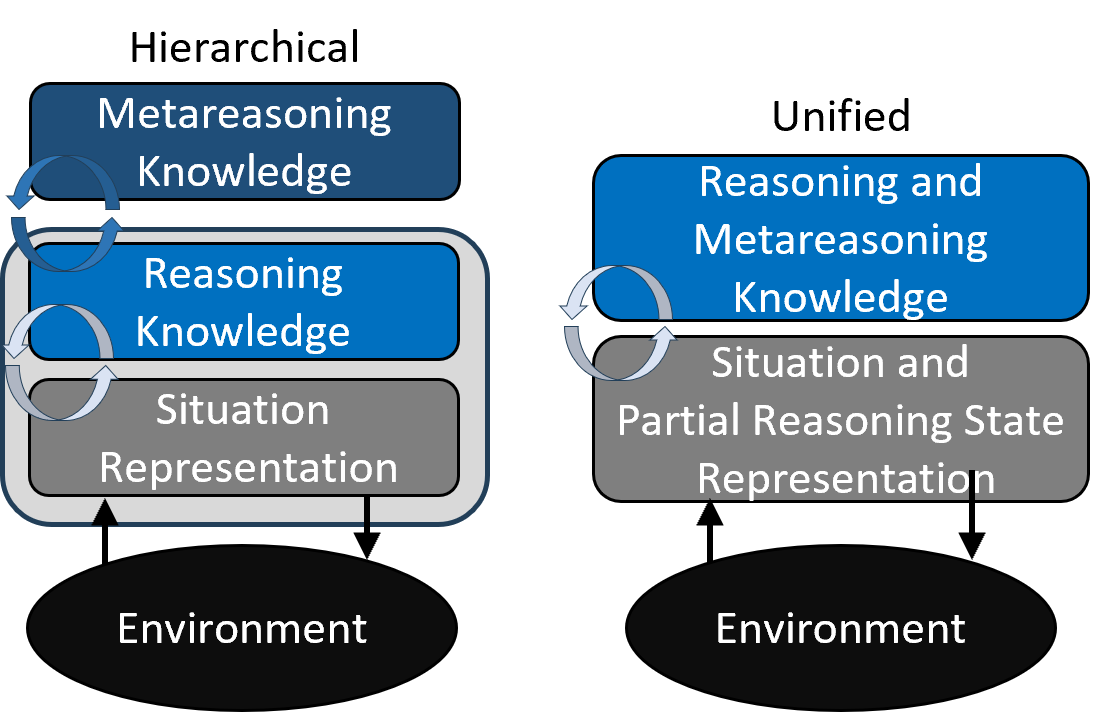
The image presents a side-by-side comparison of two conceptual models for cognitive or reasoning systems: a "Hierarchical" model on the left and a "Unified" model on the right. Both models illustrate the relationship between different types of knowledge, internal representations, and an external environment. The diagram uses colored boxes, arrows, and text to depict components and information flow.
### Components/Axes
The diagram is divided into two distinct sections:
**Left Section: Hierarchical Model**
* **Title:** "Hierarchical" (text at the top).
* **Components (from top to bottom):**
1. A dark blue, rounded rectangle labeled **"Metareasoning Knowledge"**.
2. A medium blue, rounded rectangle labeled **"Reasoning Knowledge"**.
3. A gray, rounded rectangle labeled **"Situation Representation"**.
4. A black oval at the bottom labeled **"Environment"**.
* **Arrows & Relationships:**
* A pair of curved, dark blue arrows form a circular feedback loop between the "Metareasoning Knowledge" and "Reasoning Knowledge" boxes.
* A pair of curved, light gray arrows form a circular feedback loop between the "Reasoning Knowledge" and "Situation Representation" boxes.
* A straight, black arrow points upward from the "Environment" oval to the "Situation Representation" box.
* A straight, black arrow points downward from the "Situation Representation" box to the "Environment" oval.
**Right Section: Unified Model**
* **Title:** "Unified" (text at the top).
* **Components (from top to bottom):**
1. A medium blue, rounded rectangle labeled **"Reasoning and Metareasoning Knowledge"**.
2. A gray, rounded rectangle labeled **"Situation and Partial Reasoning State Representation"**.
3. A black oval at the bottom labeled **"Environment"**.
* **Arrows & Relationships:**
* A pair of curved, light gray arrows form a circular feedback loop between the "Reasoning and Metareasoning Knowledge" box and the "Situation and Partial Reasoning State Representation" box.
* A straight, black arrow points upward from the "Environment" oval to the "Situation and Partial Reasoning State Representation" box.
* A straight, black arrow points downward from the "Situation and Partial Reasoning State Representation" box to the "Environment" oval.
### Detailed Analysis
* **Spatial Grounding:** The "Hierarchical" model is positioned on the left half of the image, and the "Unified" model is on the right. In both models, the "Environment" is the foundational element at the bottom. The knowledge/representation boxes are stacked vertically above it.
* **Component Isolation & Flow:**
* **Hierarchical Model Flow:** The environment provides input to the "Situation Representation." This representation interacts via a feedback loop with "Reasoning Knowledge," which in turn interacts via another feedback loop with the higher-level "Metareasoning Knowledge." The system outputs actions back to the environment. The architecture is strictly layered.
* **Unified Model Flow:** The environment provides input to a combined "Situation and Partial Reasoning State Representation." This integrated representation interacts via a single feedback loop with a combined "Reasoning and Metareasoning Knowledge" module. The system outputs actions back to the environment. The architecture merges previously distinct layers.
* **Text Transcription:** All text in the image is in English. The precise labels are as listed in the Components section above.
### Key Observations
1. **Structural Difference:** The core distinction is the separation versus integration of knowledge types. The Hierarchical model has three distinct layers (Metareasoning, Reasoning, Situation), while the Unified model collapses these into two integrated layers.
2. **Representational Change:** In the Unified model, the lower-level representation is not just of the external "Situation" but also includes the "Partial Reasoning State," suggesting internal cognitive state is part of the represented world.
3. **Feedback Loop Simplification:** The Hierarchical model has two separate, sequential feedback loops. The Unified model has a single, direct feedback loop between its two main components.
4. **Consistent Environment Interface:** Both models maintain identical, bidirectional interaction with the external "Environment."
### Interpretation
This diagram contrasts two fundamental approaches to designing intelligent systems.
* The **Hierarchical model** suggests a clear division of labor: low-level perception and situation assessment, middle-level reasoning for problem-solving, and high-level metareasoning for monitoring and controlling the reasoning process itself. This is analogous to a traditional management hierarchy or a computer system with distinct application, operating system, and kernel layers. It offers clarity and modularity but may introduce communication overhead and rigidity between layers.
* The **Unified model** proposes a more integrated architecture where reasoning and the meta-cognitive oversight of that reasoning are fused. Furthermore, the system's representation of the world explicitly includes its own partial reasoning state. This implies a system with greater self-awareness and potentially more fluid, adaptive cognition, as the distinction between "thinking" and "thinking about thinking" is blurred. It may be more efficient but also more complex to analyze and design.
The diagram argues that the choice between these architectures involves a trade-off between the **explicit structure and specialization** of the hierarchical approach versus the **integrated self-awareness and potential fluidity** of the unified approach. The persistence of the "Environment" as a separate, interacted-with entity in both models indicates that regardless of internal architecture, grounding and interaction with the external world remain a fundamental requirement for the system.