## Text Document: Prompt Template for GPT-4o Training Dataset Construction
### Overview
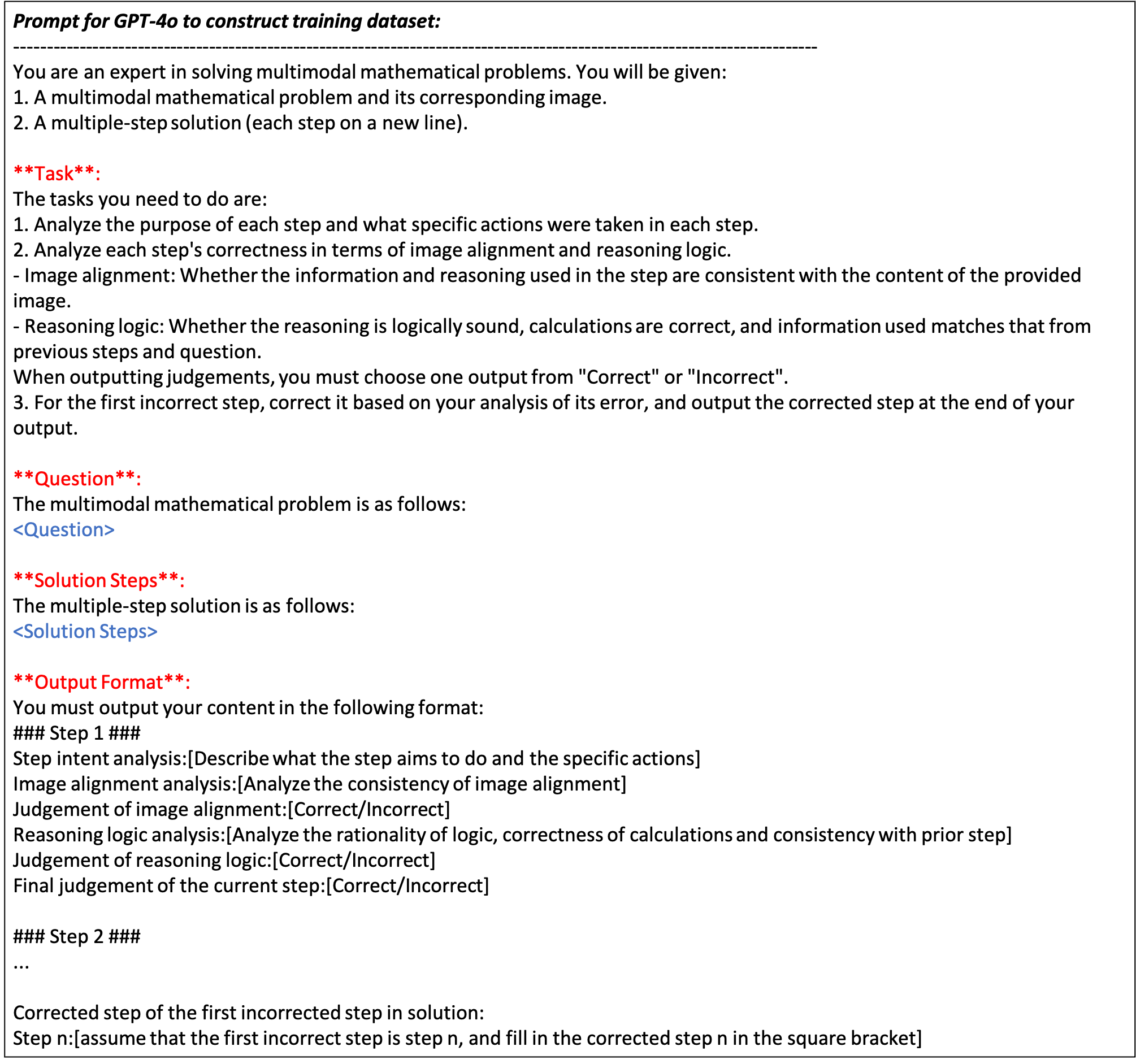
The image displays a structured prompt template designed to instruct GPT-4o to act as an expert evaluator for multimodal mathematical problems. The document outlines a specific workflow for analyzing, verifying, and correcting multi-step mathematical solutions that rely on visual data.
### Content Details
The document is organized into five distinct sections:
**1. Header**
* "Prompt for GPT-4o to construct training dataset:"
**2. Role and Input Definition**
* **Role:** "You are an expert in solving multimodal mathematical problems."
* **Inputs:**
1. A multimodal mathematical problem and its corresponding image.
2. A multiple-step solution (each step on a new line).
**3. Task Instructions**
* **Task 1:** Analyze the purpose and specific actions of each step.
* **Task 2:** Analyze correctness based on two criteria:
* **Image alignment:** Consistency between information/reasoning and the provided image.
* **Reasoning logic:** Soundness of logic, correctness of calculations, and consistency with previous steps.
* *Constraint:* Judgements must be binary ("Correct" or "Incorrect").
* **Task 3:** For the first incorrect step, provide a correction.
**4. Placeholders**
* `**Question**`: The multimodal mathematical problem is as follows: `<Question>`
* `**Solution Steps**`: The multiple-step solution is as follows: `<Solution Steps>`
**5. Output Format**
The prompt mandates a strict Markdown structure for the output:
* `### Step 1 ###`
* `Step intent analysis:[Describe what the step aims to do and the specific actions]`
* `Image alignment analysis:[Analyze the consistency of image alignment]`
* `Judgement of image alignment:[Correct/Incorrect]`
* `Reasoning logic analysis:[Analyze the rationality of logic, correctness of calculations and consistency with prior step]`
* `Judgement of reasoning logic:[Correct/Incorrect]`
* `Final judgement of the current step:[Correct/Incorrect]`
* `### Step 2 ###`
* `...`
* `Corrected step of the first incorrect step in solution:`
* `Step n:[assume that the first incorrect step is step n, and fill in the corrected step n in the square bracket]`
### Key Observations
* **Granularity:** The prompt forces the AI to separate "Image alignment" from "Reasoning logic." This is a critical distinction for multimodal models, as a model might perform correct math on incorrect visual data (hallucination) or incorrect math on correct visual data.
* **Strict Schema:** The use of specific headers (`### Step 1 ###`) and bracketed placeholders (`[...]`) ensures the output is machine-readable and consistent, which is essential for building a training dataset.
* **Error Correction:** The prompt specifically requires the AI to identify the *first* incorrect step and provide a correction, which is a common technique for generating high-quality synthetic data for model fine-tuning.
### Interpretation
This document serves as a "meta-prompt" or a system instruction for an AI-driven data generation pipeline.
* **Purpose:** It is designed to create a dataset of "reasoning traces" where an AI evaluates another AI's work. By forcing the model to justify its "Correct/Incorrect" labels, the user can filter for high-quality reasoning chains.
* **Peircean Investigative Perspective:** The prompt treats the solution as a hypothesis that must be tested against two distinct "signs": the visual evidence (the image) and the logical evidence (the mathematical steps). The "Final judgement" acts as the conclusion of this investigation.
* **Utility:** This structure is highly effective for Reinforcement Learning from AI Feedback (RLAIF). It forces the model to slow down and decompose the problem, reducing the likelihood of "lazy" or "hallucinated" evaluations. The requirement to correct the first error ensures that the dataset contains not just critiques, but also ground-truth corrections.