## Neural Network Architecture
### Overview
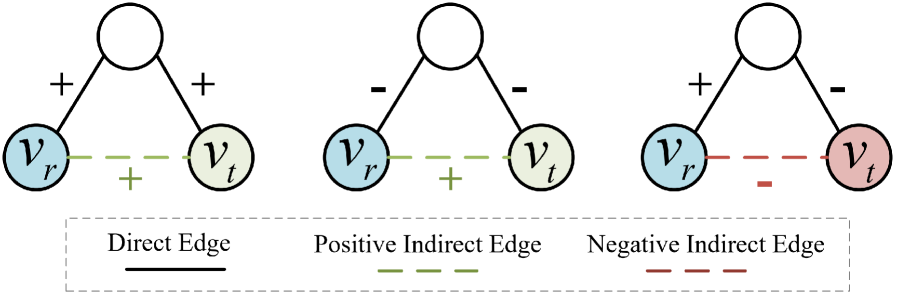
The image depicts a simplified neural network architecture consisting of three layers: an input layer, a hidden layer, and an output layer. Each layer contains a single neuron, and the neurons are connected by edges. The input layer receives input data, the hidden layer processes the data, and the output layer produces the final output.
### Components/Axes
- **Input Layer**: Contains two neurons labeled \(v_r\) and \(v_t\).
- **Hidden Layer**: Contains one neuron labeled \(v_h\).
- **Output Layer**: Contains one neuron labeled \(v_o\).
- **Edges**: Connect the neurons in the layers. There are three types of edges: direct, positive indirect, and negative indirect.
- **Legend**: Located at the bottom of the image, indicating the types of edges.
### Detailed Analysis or ### Content Details
- **Direct Edge**: The edge between \(v_r\) and \(v_h\) is solid and labeled as "Direct Edge."
- **Positive Indirect Edge**: The edge between \(v_r\) and \(v_t\) is dashed and labeled as "Positive Indirect Edge."
- **Negative Indirect Edge**: The edge between \(v_t\) and \(v_h\) is dashed and labeled as "Negative Indirect Edge."
### Key Observations
- The architecture suggests a feedforward neural network with a single hidden layer.
- The direct edge indicates a direct connection between the input and hidden layers.
- The positive indirect edge suggests a connection between the input and output layers through the hidden layer.
- The negative indirect edge suggests a connection between the output and hidden layers through the hidden layer.
### Interpretation
The neural network architecture shown in the image is a simple feedforward network with a single hidden layer. The direct edge indicates a direct connection between the input and hidden layers, which is typical in neural networks for processing input data. The positive indirect edge suggests that the hidden layer processes the input data and then passes the processed information to the output layer. The negative indirect edge suggests that the output layer processes the information from the hidden layer and produces the final output.
The interpretation of the data suggests that the neural network is designed to process input data and produce an output based on the processed information. The direct edge indicates a direct connection between the input and hidden layers, which is typical in neural networks for processing input data. The positive indirect edge suggests that the hidden layer processes the input data and then passes the processed information to the output layer. The negative indirect edge suggests that the output layer processes the information from the hidden layer and produces the final output.
In summary, the neural network architecture shown in the image is a simple feedforward network with a single hidden layer. The direct edge indicates a direct connection between the input and hidden layers, the positive indirect edge suggests that the hidden layer processes the input data and then passes the processed information to the output layer, and the negative indirect edge suggests that the output layer processes the information from the hidden layer and produces the final output.