## Line Chart: Cost vs. Queries for Natural Language and Agora
### Overview
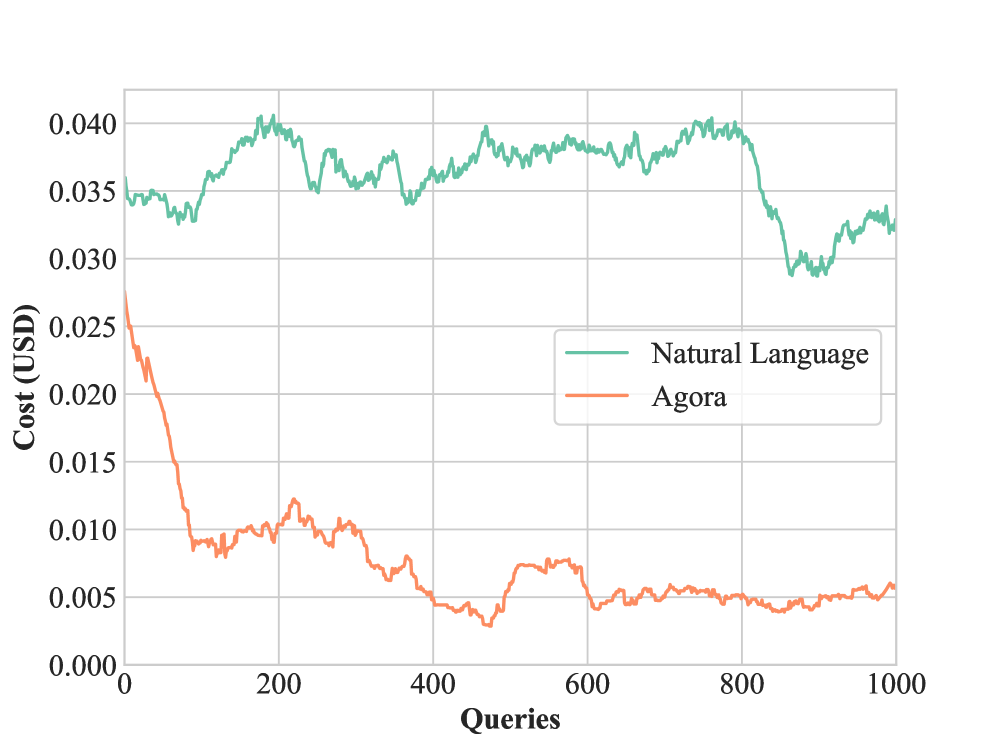
The image is a line chart comparing the cost (in USD) of "Natural Language" and "Agora" queries over a range of 0 to 1000 queries. The chart displays how the cost fluctuates for each method as the number of queries increases.
### Components/Axes
* **X-axis:** "Queries" ranging from 0 to 1000, with tick marks at 0, 200, 400, 600, 800, and 1000.
* **Y-axis:** "Cost (USD)" ranging from 0.000 to 0.040, with tick marks at 0.000, 0.005, 0.010, 0.015, 0.020, 0.025, 0.030, 0.035, and 0.040.
* **Legend:** Located in the center-right of the chart.
* **Natural Language:** Represented by a teal line.
* **Agora:** Represented by a light orange line.
### Detailed Analysis
* **Natural Language (Teal Line):**
* Trend: Generally stable with some fluctuations.
* Initial Cost (at 0 queries): Approximately 0.034 USD.
* Cost at 200 queries: Approximately 0.039 USD.
* Cost at 400 queries: Approximately 0.036 USD.
* Cost at 800 queries: Approximately 0.030 USD.
* Cost at 1000 queries: Approximately 0.033 USD.
* **Agora (Light Orange Line):**
* Trend: Decreases sharply initially, then stabilizes at a lower cost.
* Initial Cost (at 0 queries): Approximately 0.028 USD.
* Cost at 200 queries: Approximately 0.010 USD.
* Cost at 400 queries: Approximately 0.007 USD.
* Cost at 800 queries: Approximately 0.005 USD.
* Cost at 1000 queries: Approximately 0.005 USD.
### Key Observations
* The cost of "Natural Language" queries remains relatively constant, fluctuating between approximately 0.030 and 0.040 USD.
* The cost of "Agora" queries decreases significantly in the initial phase (0-400 queries) and then stabilizes at a much lower cost, around 0.005 USD.
* "Agora" is significantly cheaper than "Natural Language" after the initial decrease.
### Interpretation
The chart suggests that "Agora" is a more cost-effective solution for a large number of queries compared to "Natural Language." While "Natural Language" maintains a stable cost, "Agora" rapidly decreases in cost and remains low, making it potentially more scalable and economical for applications involving numerous queries. The initial higher cost of Agora may be due to initial setup or overhead, but the long-term cost benefit is clear.