## Line Chart: Number of Operations vs Reasoning Steps
### Overview
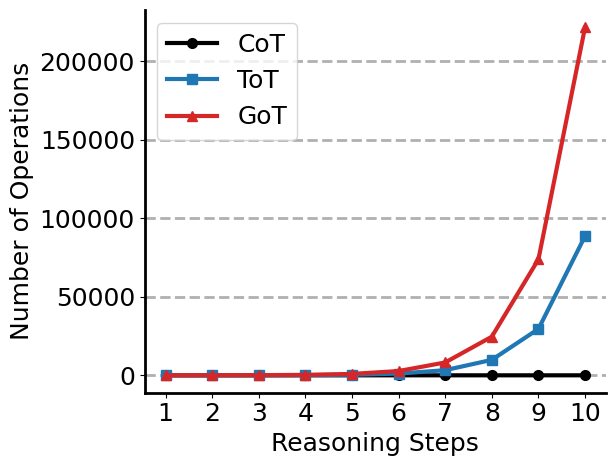
The chart displays three data series (CoT, ToT, GoT) across 10 reasoning steps, showing the number of operations required at each step. The y-axis scales logarithmically up to 200,000 operations, while the x-axis represents discrete reasoning steps 1-10.
### Components/Axes
- **X-axis**: Reasoning Steps (1-10, integer increments)
- **Y-axis**: Number of Operations (0-200,000, increments of 50,000)
- **Legend**:
- CoT: Black line with circular markers (constant at 0)
- ToT: Blue line with square markers (gradual increase)
- GoT: Red line with triangular markers (sharp late-stage increase)
- **Positioning**: Legend in top-left corner; data series anchored to bottom-left origin
### Detailed Analysis
1. **CoT (Black)**:
- Flat line at 0 operations across all steps
- No variation observed (0 ± 0 operations)
2. **ToT (Blue)**:
- Flat at 0 until step 7
- Step 8: ~10,000 operations
- Step 9: ~30,000 operations
- Step 10: ~90,000 operations
3. **GoT (Red)**:
- Flat at 0 until step 7
- Step 8: ~10,000 operations
- Step 9: ~70,000 operations
- Step 10: ~220,000 operations (steep upward spike)
### Key Observations
- CoT maintains perfect operational stability (0 operations)
- ToT and GoT show identical behavior until step 7
- Both ToT and GoT exhibit exponential growth between steps 8-10
- GoT's operations at step 10 are 2.44× higher than ToT's
- All data series share identical initial conditions (0 operations)
### Interpretation
The chart reveals a critical divergence in computational demands between ToT and GoT during final reasoning steps. While CoT demonstrates perfect operational efficiency (0 cost), ToT and GoT both require minimal resources until the final step, where GoT's operations surge dramatically. This suggests:
1. **Algorithmic Bottlenecks**: GoT's late-stage operations may involve complex computations or recursive processes
2. **Resource Allocation**: The 2.44× difference between ToT and GoT at step 10 indicates potential inefficiencies in GoT's implementation
3. **Threshold Effects**: The step-7 plateau suggests a computational threshold being crossed at later stages
4. **Scalability Concerns**: GoT's exponential growth pattern raises questions about its practicality for extended reasoning tasks
The data implies that while CoT offers optimal efficiency, ToT and GoT trade increased operational costs for potentially enhanced reasoning capabilities in later stages. The stark contrast at step 10 warrants further investigation into GoT's computational architecture.