\n
## Diagram: Automated Function Generation Pipeline
### Overview
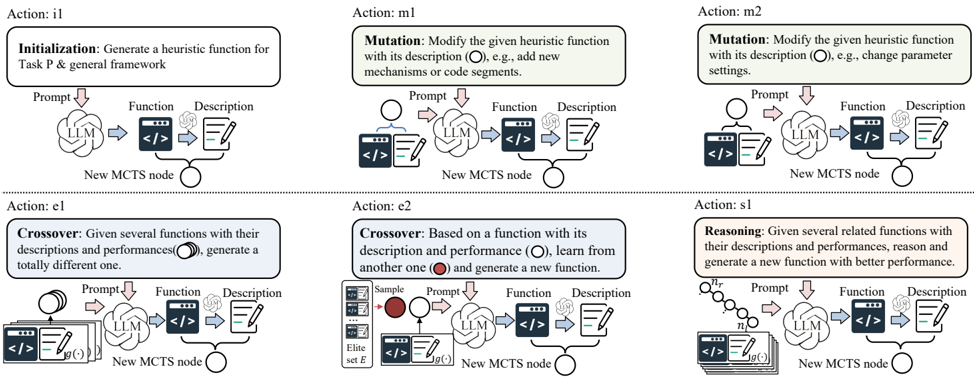
The image depicts a diagram illustrating a pipeline for automated function generation, likely within a reinforcement learning or automated programming context. It shows six distinct "Actions" (i1, m1, m2, e1, e2, s1), each representing a step in the process of creating and refining functions. Each action involves a Large Language Model (LLM), a function, a description, and the creation of a new MCTS (Monte Carlo Tree Search) node.
### Components/Axes
The diagram consists of six horizontally arranged blocks, each labeled with an "Action:" prefix followed by a short identifier (i1, m1, m2, e1, e2, s1). Each block contains the following elements:
* **Prompt:** Represented by a cloud shape with the word "Prompt" inside.
* **LLM:** A rectangular box with a computer icon, labeled "LLM".
* **Function:** A rectangular box with `</>` inside, labeled "Function".
* **Description:** A rectangular box with a document icon, labeled "Description".
* **New MCTS node:** A circular node labeled "New MCTS node".
* **Arrows:** Arrows indicate the flow of information between these components.
* **Additional elements:** Some actions include additional elements like "Sample", "Elite set E", and mathematical notations (η, η(c)).
### Detailed Analysis or Content Details
**Action: i1 (Initialization)**
* Text: "Initialization: Generate a heuristic function for Task P & general framework"
* Flow: Prompt -> LLM -> Function -> Description -> New MCTS node.
**Action: m1 (Mutation)**
* Text: "Mutation: Modify the given heuristic function with its description (O), e.g., add new mechanisms or code segments."
* Flow: Prompt -> LLM -> Function -> Description -> New MCTS node.
* "O" is present in parentheses next to "description".
**Action: m2 (Mutation)**
* Text: "Mutation: Modify the given heuristic function with its description (O), e.g., change parameter settings."
* Flow: Prompt -> LLM -> Function -> Description -> New MCTS node.
* "O" is present in parentheses next to "description".
**Action: e1 (Crossover)**
* Text: "Crossover: Given several functions with their descriptions and performances(O), generate a totally different one."
* Flow: `</>` -> Prompt -> LLM -> Function -> Description -> New MCTS node.
* "O" is present in parentheses next to "performances".
* "y(x)" is present next to the arrow from `</>` to Prompt.
**Action: e2 (Crossover)**
* Text: "Crossover: Based on a function with its description and performance (O), learn from another one (O) and generate a new function."
* Flow: "Sample" -> Prompt -> LLM -> Function -> Description -> New MCTS node.
* "Elite set E" is present next to "Sample".
* "O" is present in parentheses next to "performance" and "another one".
**Action: s1 (Reasoning)**
* Text: "Reasoning: Given several related functions with their descriptions and performances, reason and generate a new function with better performance."
* Flow: "η" -> Prompt -> LLM -> Function -> Description -> New MCTS node.
* "η(c)" is present next to the arrow from "η" to Prompt.
### Key Observations
* The LLM appears to be central to all actions, suggesting it's the core component for function generation and modification.
* The "Description" component is consistently present, indicating that function descriptions play a crucial role in the process.
* The actions "m1" and "m2" both involve "Mutation", but differ in the type of modification (adding mechanisms vs. changing parameters).
* The actions "e1" and "e2" both involve "Crossover", but differ in the input and process.
* The "O" notation consistently appears next to "description" or "performance", potentially representing an observation or output.
* The use of "Elite set E" in "e2" suggests a selection mechanism for crossover.
* The mathematical notations "η" and "η(c)" in "s1" suggest a quantitative approach to reasoning.
### Interpretation
This diagram illustrates a sophisticated automated function generation pipeline leveraging a Large Language Model (LLM) and Monte Carlo Tree Search (MCTS). The pipeline employs a variety of techniques – Initialization, Mutation, Crossover, and Reasoning – to iteratively improve functions. The consistent inclusion of function descriptions suggests a focus on generating functions that are not only functional but also understandable and explainable. The "O" notation likely represents the observed output or performance of the function, used for guiding the iterative refinement process. The use of MCTS nodes indicates that the pipeline is likely exploring a search space of possible functions, guided by the LLM and the evaluation of function performance. The diagram suggests a system designed for automated algorithm discovery or program synthesis, where the LLM acts as a creative engine and MCTS provides a structured search strategy. The different crossover and mutation strategies suggest an attempt to balance exploration and exploitation in the search space.