## Line Chart: Accuracy vs. Thoughts per Step
### Overview
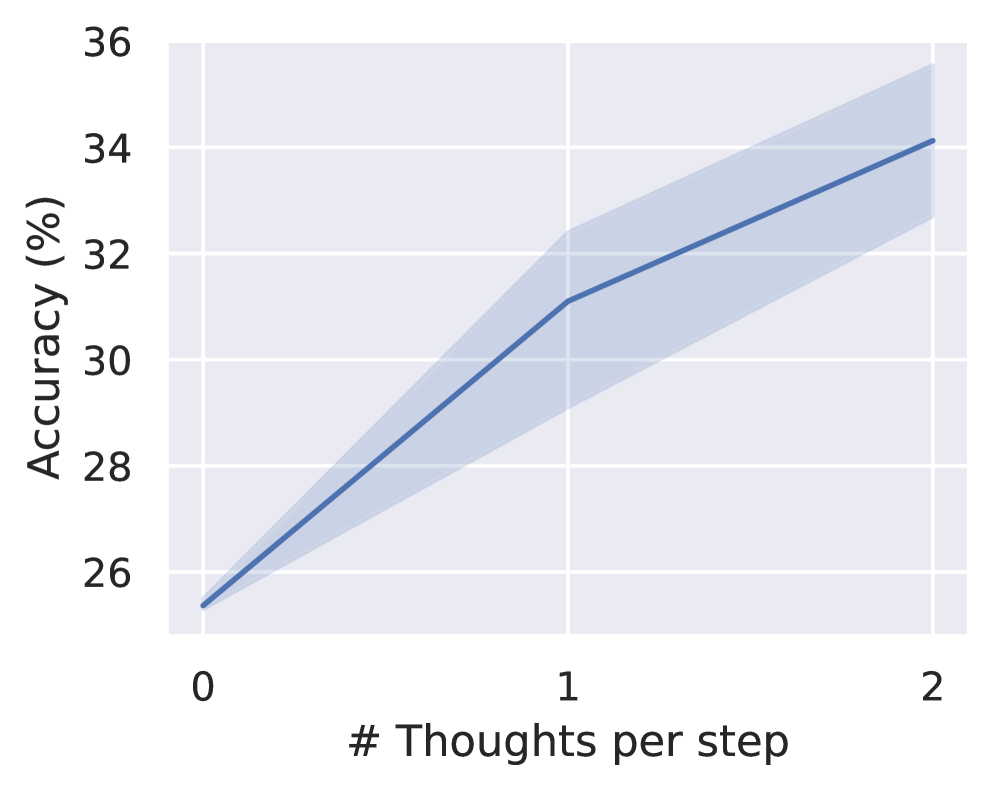
The image displays a line chart plotting the relationship between the number of thoughts per step (x-axis) and the resulting accuracy percentage (y-axis). The chart features a single data series represented by a solid blue line, accompanied by a semi-transparent blue shaded region indicating a confidence interval or range of uncertainty around the central trend.
### Components/Axes
* **Chart Type:** Line chart with a confidence band.
* **X-Axis:**
* **Label:** "# Thoughts per step"
* **Scale:** Linear, with major tick marks and labels at the integer values 0, 1, and 2.
* **Y-Axis:**
* **Label:** "Accuracy (%)"
* **Scale:** Linear, with major tick marks and labels at 26, 28, 30, 32, 34, and 36.
* **Data Series:**
* A single, solid blue line representing the central trend (e.g., mean or median accuracy).
* A semi-transparent blue shaded area surrounding the line, representing the confidence interval or variability.
* **Legend:** No explicit legend is present in the image. The single data series and its confidence band are self-explanatory from the axis labels.
* **Spatial Layout:** The chart area is bounded by a light gray grid. The axes labels are positioned conventionally: the x-axis label is centered below the axis, and the y-axis label is rotated 90 degrees and positioned to the left of the axis.
### Detailed Analysis
* **Trend Verification:** The solid blue line exhibits a clear, positive, upward slope from left to right. This indicates that as the number of thoughts per step increases, the measured accuracy also increases.
* **Data Point Extraction (Approximate):**
* At **# Thoughts per step = 0**: The line starts at an accuracy of approximately **25.5%**. The confidence interval at this point is relatively narrow, spanning roughly from 25.0% to 26.0%.
* At **# Thoughts per step = 1**: The line passes through an accuracy of approximately **31.2%**. The confidence interval has widened, spanning roughly from 29.5% to 32.8%.
* At **# Thoughts per step = 2**: The line ends at an accuracy of approximately **34.2%**. The confidence interval is at its widest here, spanning roughly from 32.8% to 35.6%.
* **Confidence Interval Behavior:** The shaded blue region (confidence interval) is narrowest at the starting point (0 thoughts) and progressively widens as the number of thoughts per step increases. This indicates that the estimate of accuracy becomes less precise (has greater uncertainty) for higher numbers of thoughts per step.
### Key Observations
1. **Positive Correlation:** There is a strong, positive relationship between the number of thoughts per step and accuracy.
2. **Diminishing Returns:** The slope of the line appears slightly steeper between 0 and 1 thoughts per step than between 1 and 2, suggesting the marginal gain in accuracy may decrease with additional thoughts.
3. **Increasing Uncertainty:** The widening confidence interval is a critical feature. While average accuracy improves with more thoughts, the range of possible outcomes (or the uncertainty in the estimate) also expands significantly.
### Interpretation
The data suggests that allocating more "thoughts" (likely referring to computational steps, reasoning iterations, or internal processing cycles) per decision step in a system leads to a measurable improvement in its accuracy. This is a common pattern in complex problem-solving or AI systems, where additional computation allows for more exploration, verification, or refinement of a solution.
However, the chart reveals a crucial trade-off: **increased performance comes with increased variability or uncertainty.** The widening confidence band implies that while the system's *average* performance improves, its *consistency* may decrease. At 2 thoughts per step, the system has a higher average accuracy than at 0 or 1, but the range of possible accuracy scores is much broader. This could mean that in some runs, the system performs exceptionally well (near 35.6%), while in others, it performs only marginally better than the average at 1 thought per step (near 32.8%).
This pattern is vital for system design. If reliability and predictability are paramount, the optimal operating point might be at 1 thought per step, where accuracy is good and uncertainty is moderate. If maximizing peak performance is the goal and some variability is acceptable, then 2 thoughts per step is preferable. The chart does not show data beyond 2 thoughts, so it is unknown if accuracy plateaus or if uncertainty continues to grow.